
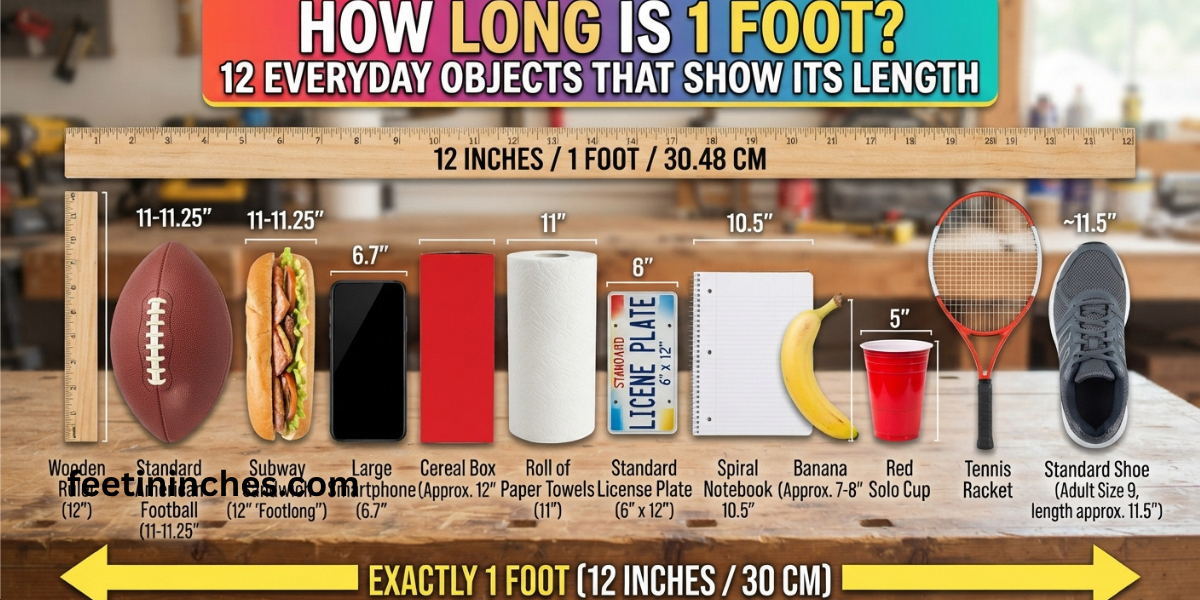
Have you ever needed to measure something but had no ruler nearby? Maybe you wanted to check the length of a shelf, estimate the size of a package, or work out whether an item would fit inside a small space. Knowing how long one foot is can help you make a quick estimate without searching for a measuring tool.
One foot is a familiar unit of length, but it can be difficult to visualize when you have nothing to compare it with. Everyday objects make the measurement easier to understand. A standard ruler, a sheet of paper, a water bottle, and several household items can help you picture this distance.
One foot equals exactly 12 inches, 30.48 centimeters, or 0.3048 meters. This is the standard international definition of a foot. The conversion is exact, according to the National Institute of Standards and Technology. Read the official measurement reference.
In this guide, you will discover 12 everyday objects that help you visualize one foot. You will also learn how to estimate the measurement, convert it into other units, and avoid common measuring mistakes.
How Long Is 1 Foot Exactly?
One foot is a unit of length in the customary measurement system. It is commonly used to describe furniture, household objects, building materials, and human height.
The abbreviation for foot is ft. The symbol for feet is also ft, whether you describe one foot or several feet.
Here are the exact conversions for one foot:
| Unit | Equivalent |
|---|---|
| Inches | 12 inches |
| Centimeters | 30.48 cm |
| Meters | 0.3048 m |
| Millimeters | 304.8 mm |
| Yards | One-third of a yard |
The most useful conversion to remember is 12 inches. If you know the length of an inch, you can calculate a foot by combining 12 inches.
For example, a 24-inch shelf measures 2 feet long. A 36-inch table measures 3 feet long. These simple relationships make everyday measurements easier.
Is 1 Foot the Same as 12 Inches?
Yes. One foot always equals 12 inches under the standard international definition.
This relationship does not change based on the object being measured. A wooden board, a piece of fabric, and a metal ruler all use the same conversion.
However, remember that an object’s advertised size may be rounded. A product described as approximately one foot long might measure slightly more or less than 12 inches.
How Long Is 1 Foot in Centimeters?
One foot measures exactly 30.48 centimeters.
To convert feet into centimeters, multiply the number of feet by 30.48.
For example:
- 1 foot = 30.48 cm
- 2 feet = 60.96 cm
- 3 feet = 91.44 cm
- 5 feet = 152.4 cm
This conversion is useful when shopping from international websites or following instructions that use the metric system.
12 Everyday Objects That Help You Visualize 1 Foot
You do not need to memorize every conversion to understand a foot. You can use familiar objects as visual references.
The following examples offer practical ways to estimate this length. Keep in mind that product dimensions vary, so these comparisons are approximations unless the object’s measured length is exactly 12 inches.
1. A Standard 12-Inch Ruler
A standard 12-inch ruler is one of the simplest ways to visualize a foot.
Many school and office rulers measure exactly 12 inches from one end to the other. Some rulers include extra material beyond the measurement marks, so check the scale rather than relying on the plastic edge.
Place the ruler beside an object you want to measure. If the object reaches the 12-inch mark, it measures one foot.
A ruler is particularly useful for measuring books, small boxes, notebooks, and craft materials.
Best use: Measuring short objects accurately at home, school, or work.
2. A Sheet of Letter-Size Paper
A standard US letter-size sheet measures 8.5 inches wide and 11 inches long. Its longer edge is therefore close to one foot.
The difference is only one inch. That makes the longer edge a convenient reference when estimating a foot without a ruler.
Place the paper beside a book or package. If the item is slightly longer than the paper’s long edge, it may be close to 12 inches.
Remember that A4 paper is a different size. It measures approximately 8.27 by 11.69 inches, making its longer edge closer to one foot.
Best use: Quick estimates when you have ordinary printer paper nearby.
3. A Large Water Bottle
Some reusable water bottles measure around one foot tall, especially larger bottles designed for travel or outdoor activities.
However, water bottles come in many shapes and capacities. A compact bottle might be much shorter, while a large insulated bottle could exceed 12 inches.
For a reliable comparison, measure the bottle from its base to its highest point. Include the lid if you want to compare its full height.
A bottle measuring 12 inches tall provides a convenient reference for estimating the height of similar objects.
Best use: Visualizing the height of small containers, desk accessories, or household products.
4. A Foot-Long Sandwich
A foot-long sandwich is a familiar example of food sold in a nominal 12-inch size.
Its advertised length makes it an easy mental reference. Imagine a sandwich stretching across a tray. That distance gives you a useful picture of one foot.
Actual sandwich lengths can vary because bread is not manufactured like a precision measuring instrument. Do not treat food portions as exact measurement standards.
Still, this example works well when you want to explain a foot to someone who does not regularly use inches.
Best use: Everyday conversations and quick visual estimates.
5. A Large Kitchen Knife
Some kitchen knives have blades or total lengths close to one foot. A chef’s knife, however, can vary considerably in size.
Always distinguish between the blade length and the knife’s overall length. A knife with a 12-inch total length may have a blade that is considerably shorter.
For safety, never use a sharp knife as a measuring tool by placing it against your body or other objects. A ruler or tape measure is a better choice for actual measurements.
Best use: Understanding approximate dimensions when looking at kitchen tools.
6. A Small Laptop or Laptop Sleeve
Some compact laptops and laptop sleeves have dimensions close to one foot along one side.
But screen size does not tell you the laptop’s overall length. Laptop screens are measured diagonally, from one corner to the opposite corner.
A laptop with a 12-inch screen may therefore be longer or shorter than 12 inches along its widest edge.
If you want to use a laptop as a reference, measure the actual body or sleeve. That gives you a more dependable comparison.
Best use: Estimating the dimensions of electronics and protective cases.
7. A Short Pillow
Some small decorative pillows measure around 12 inches across. Their soft edges and flexible filling make them less precise than rigid objects.
A pillow may also compress when you handle it. Its dimensions can change depending on how tightly the filling is packed.
If a pillow measures 12 inches from one side to the other when resting naturally, it provides a useful visual example of a foot.
This comparison is especially helpful when arranging cushions or estimating the space needed for small home accessories.
Best use: Visualizing approximate dimensions in bedrooms and living rooms.
8. A Small Wall Clock
Some compact wall clocks measure approximately one foot in diameter.
A circular clock provides a different way to picture length. Instead of looking at a straight edge, you can compare the distance across the clock through its center.
For example, a clock with a 12-inch diameter measures one foot from one outer edge to the opposite outer edge.
Do not confuse diameter with circumference. The circumference is the distance around the clock and is much greater than one foot.
Best use: Understanding diameter and comparing round household objects.
9. A Short Desk Organizer
Some desk organizers measure close to 12 inches along their longest side.
These containers often hold pens, notebooks, cables, and other office supplies. Their rectangular shape makes it easy to compare one edge with a ruler.
Measure the longest side rather than the height or depth. A desk organizer might be 12 inches wide but only a few inches tall.
This example also shows why you should identify which dimension matters before measuring an object.
Best use: Planning desk layouts and estimating storage space.
10. A Small Wooden Board
A short wooden board can provide a good example of a one-foot length.
Lumber is often sold in standard lengths, although the exact dimensions depend on the product and supplier. A board cut to 12 inches offers a direct comparison.
Place the board on a flat surface and measure from one end to the other. Avoid measuring diagonally, because that produces a different distance.
A wooden board is also useful when planning small DIY projects. Accurate measurements help reduce wasted materials and improve the fit between components.
Best use: Craft projects, simple repairs, and home improvement.
11. A Long Cooking Utensil
Some cooking utensils, such as serving spoons, spatulas, and kitchen tongs, measure close to one foot overall.
Their dimensions vary by design. A short serving spoon may be much smaller, while a long grilling utensil may be considerably longer.
Compare the utensil’s full length, including its handle. If it measures 12 inches from end to end, it is exactly one foot long.
This example is especially useful in a kitchen where a measuring tape may not be immediately available.
Best use: Estimating the length of household tools and accessories.
12. A Short Piece of String
A piece of string cut to 12 inches is one of the most flexible ways to demonstrate a foot.
Unlike a rigid ruler, string can follow curves and fit around objects. However, it can stretch or sag, which may affect the measurement.
To make a reliable reference, measure 12 inches of string against a ruler first. Mark both ends clearly before using it.
You can then keep the string in a drawer or toolbox for quick comparisons. It is simple, inexpensive, and easy to carry.
Best use: Crafting, sewing preparation, and rough measurements around the house.
Quick Comparison Table: Objects Close to One Foot
The table below summarizes the 12 examples. It distinguishes exact measurement references from objects whose dimensions vary.
| Everyday object | How it compares with 1 foot | Accuracy |
|---|---|---|
| 12-inch ruler | Exactly 12 inches between measurement endpoints | Exact when verified |
| Letter-size paper | Long edge is 11 inches | Close |
| Large water bottle | Some models are around 12 inches tall | Varies |
| Foot-long sandwich | Nominally 12 inches | Approximate |
| Large kitchen knife | Some total lengths approach 12 inches | Varies |
| Compact laptop or sleeve | Some dimensions approach 12 inches | Varies |
| Small pillow | Some widths approach 12 inches | Varies |
| Small wall clock | A 12-inch diameter equals one foot | Exact when verified |
| Desk organizer | Some lengths approach 12 inches | Varies |
| Wooden board | A board cut to 12 inches equals one foot | Exact when verified |
| Cooking utensil | Some total lengths approach 12 inches | Varies |
| String | A measured 12-inch piece equals one foot | Exact when verified |
The key lesson is simple. Familiar objects can help you estimate a foot, but their dimensions should not be assumed.
If accuracy matters, use a ruler or measuring tape.
How Can You Measure One Foot Without a Ruler?
You can estimate a foot by comparing an object with something whose dimensions you already know.
Here are three practical methods.
Method 1: Use a Sheet of Paper
Place the long edge of standard letter-size paper beside the object. The paper measures 11 inches, so a foot is one inch longer.
This method works best when you need a rough estimate rather than a precise result.
Method 2: Use a Known Object
Find an item with a verified 12-inch measurement. A ruler, measured wooden strip, or marked piece of string works well.
Place it next to the item you want to measure. Align the starting points and compare their endpoints.
Method 3: Estimate in Smaller Sections
One foot contains 12 inches. You can divide the length mentally into smaller sections, such as three groups of four inches.
This method helps when you understand inches but do not have a ruler. However, visual estimates can accumulate errors, so avoid using them for precise construction work.
Why Hand Measurements Are Not Always Reliable
Your hand span may seem like a convenient measuring tool. However, hand sizes differ between people.
The width of your palm is not a standard unit. If you use your hand to estimate one foot, your result may differ from another person’s estimate.
You can calibrate your hand span by measuring it once. After that, it may serve as a rough personal reference, but it should not replace a measuring tool when precision matters.
How Do You Convert One Foot Into Other Measurements?
Converting one foot is straightforward because the standard relationships are fixed.
The National Institute of Standards and Technology provides authoritative conversion references for customary and metric units. Its published tables confirm that one international foot equals 0.3048 meters exactly. View NIST’s conversion guidance.
Use these formulas when converting other measurements.
- Feet to inches: Multiply feet by 12.
- Feet to centimeters: Multiply feet by 30.48.
- Feet to meters: Multiply feet by 0.3048.
- Inches to feet: Divide inches by 12.
- Centimeters to feet: Divide centimeters by 30.48.
For example, suppose a package measures 24 inches long. Divide 24 by 12 to get 2 feet.
If a shelf measures 60.96 centimeters, divide that measurement by 30.48. The result is 2 feet.
These conversions are useful for shopping, furniture planning, school assignments, and basic DIY tasks.
Is One Foot a Long Distance?
One foot is a short distance compared with a yard or a meter. However, it can be significant when measuring small objects.
A foot is long enough to describe the width of some shelves, the height of certain containers, or the length of a short board.
It is also a convenient building block for larger measurements. Three feet make one yard, while five feet make 60 inches.
When you need to measure a room, a doorway, or a large piece of furniture, several feet may be more practical than individual inches.
The important factor is context. One foot may seem small in a large room but substantial when comparing two compact objects.
Common Mistakes When Estimating One Foot
Estimating length is easy to do incorrectly when you rely entirely on appearances.
Avoid these common mistakes.
Confusing Height With Length
An object can be one foot tall without being one foot long. Always identify the dimension you need.
For example, a bottle may be 12 inches tall but only 3 inches wide.
Assuming Similar Objects Have Identical Sizes
Two water bottles can look almost identical while having different heights. Manufacturers use different designs, capacities, and proportions.
Measure the actual object when the result matters.
Forgetting That Paper Sizes Differ
US letter paper measures 8.5 by 11 inches. A4 paper measures approximately 8.27 by 11.69 inches.
Both can help you visualize a foot, but neither has a 12-inch edge.
Measuring From the Wrong Starting Point
Place the zero mark at the beginning of the object. Do not automatically align the object with the physical end of a ruler.
Some rulers have a small blank section before the zero mark. Ignoring it can lead to an incorrect measurement.
Treating Estimates as Exact Measurements
A visual comparison can help you understand length, but it cannot guarantee precision.
Use a tape measure or ruler when cutting materials, ordering fitted furniture, or checking product dimensions.
Why Is Knowing One Foot Useful in Everyday Life?
Understanding one foot can save time when you estimate the size of household objects.
For example, you might need to decide whether a storage box will fit on a shelf. You may want to check the approximate length of a package before ordering it. You might also need to compare dimensions on a product listing.
A familiar reference makes these decisions easier.
However, there is an important difference between estimating and measuring. Estimation helps you decide what is likely to fit. Measurement confirms whether it actually fits.
If you are installing a shelf, cutting wood, arranging furniture, or buying something for a specific space, check the actual dimensions before making a final decision.
A small measuring error can matter when two pieces must fit together.
Frequently Asked Questions
1. How long is 1 foot in inches?
One foot equals exactly 12 inches. This is the standard relationship between feet and inches in the international foot definition.
2. How long is 1 foot in centimeters?
One foot equals exactly 30.48 centimeters. Multiply the number of feet by 30.48 to convert feet into centimeters.
3. Is 1 foot longer than 30 centimeters?
Yes. One foot measures 30.48 centimeters, which is 0.48 centimeters longer than 30 centimeters.
4. What household item is exactly one foot long?
A verified 12-inch ruler or a piece of string measured to exactly 12 inches can represent one foot. Most ordinary household objects vary in size.
5. Is a sheet of paper one foot long?
Not usually. US letter paper measures 11 inches along its longer edge. A4 paper measures approximately 11.69 inches along its longer edge.
6. How many feet are in 24 inches?
There are 2 feet in 24 inches. Divide the number of inches by 12 to convert inches into feet.
7. How many millimeters are in one foot?
One foot equals exactly 304.8 millimeters. This is useful when working with metric measurements or small construction projects.
8. Can I use my hand to measure one foot?
You can use your hand for a rough estimate, but hand sizes vary. Measure your hand span first if you want to use it as a personal reference.
9. How can I measure one foot without a measuring tape?
Use a verified 12-inch ruler, a marked piece of string, or another object with known dimensions. These references are more dependable than guessing.
10. Is one foot the same as one-third of a yard?
Yes. One yard equals three feet, so one foot is exactly one-third of a yard.
11. How many feet are in one meter?
One meter is approximately 3.28084 feet. Conversely, one foot equals exactly 0.3048 meters.
12. Why do some objects described as one foot long measure differently?
Product dimensions may be rounded, approximate, or measured using different reference points. Always check the manufacturer’s specifications when exact dimensions matter.
Conclusion
One foot is a simple measurement once you connect it with familiar objects. It equals exactly 12 inches, 30.48 centimeters, and 0.3048 meters.
A standard ruler offers the clearest reference. Paper, water bottles, kitchen utensils, pillows, and other household objects can help you picture the distance, provided you remember that their sizes vary.
The best approach is to combine visual estimation with accurate measurement. Use familiar objects when you need a quick idea of length. Reach for a ruler or tape measure when precision matters.
Once you recognize what 12 inches looks like, estimating short distances becomes much easier.
Which everyday object do you find most helpful for visualizing one foot? Share your example or question, and use it as a starting point for your next measurement.
Leave a Reply