
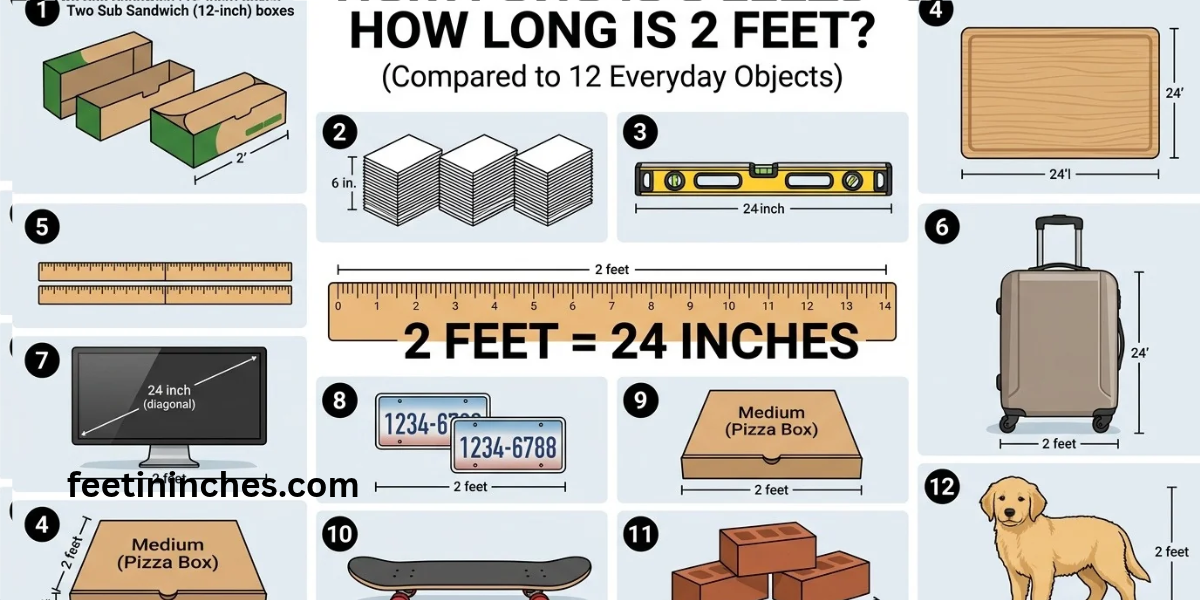
Have you ever needed to measure something but couldn’t find a ruler or measuring tape? Maybe you’re checking whether a small shelf will fit, estimating the length of a box, or trying to picture a distance described in feet. Knowing a few everyday measurements can make these tasks much easier.
So, how long is 2 feet?
Two feet is exactly 24 inches, or 60.96 centimeters. It is also equal to 0.6096 meters. You can imagine this length as a little longer than a standard school ruler placed end to end with another ruler of the same length.
However, rulers aren’t the only way to picture this measurement. Many familiar objects can help you estimate 2 feet without measuring every inch.
In this guide, we’ll compare 2 feet with 12 everyday objects, including household items, common tools, and familiar products. You’ll also learn how to convert feet into inches and centimeters, estimate this length by sight, and avoid common measuring mistakes.
Keep in mind that everyday objects come in different sizes. These comparisons are useful estimates rather than exact measurements unless the object’s dimensions are specified.
How Long Is 2 Feet in Inches, Centimeters, and Meters?
Two feet is a length of 24 inches. In the metric system, it measures 60.96 centimeters or 0.6096 meters. These conversions use the standard international definitions of the foot and inch. The National Institute of Standards and Technology provides authoritative conversion information for these units.
Here are the basic conversions.
| Measurement unit | Equivalent length |
|---|---|
| Feet | 2 feet |
| Inches | 24 inches |
| Centimeters | 60.96 cm |
| Meters | 0.6096 m |
| Millimeters | 609.6 mm |
| Yards | 0.6667 yard, approximately |
The simplest way to remember this measurement is to think of two groups of 12 inches. Each foot contains 12 inches, so multiplying 2 by 12 gives 24 inches.
For readers who prefer metric measurements, 2 feet is just under 61 centimeters. That makes it slightly longer than half a meter.
You can verify the conversion using the NIST measurement conversion reference.
Is 2 Feet Long or Short?
Two feet is a relatively short distance compared with the height of an adult or the length of a dining table. However, it can be substantial for smaller household objects.
For example, 24 inches is a useful reference when estimating the width of a small table, the length of a storage container, or the space needed for a compact shelf.
The important point is that length depends on context. Two feet might seem long when measuring a handbag, yet short when measuring a room.
12 Everyday Objects That Help You Visualize 2 Feet
The easiest way to understand a measurement is to compare it with something familiar. The following examples offer practical reference points for visualizing a 24-inch length.
Some examples are close estimates. Others depend on the specific product or model, so check the manufacturer’s dimensions whenever accuracy matters.
1. Two Standard 12-Inch Rulers
<em>Estimated comparison: exactly 24 inches when both rulers measure 12 inches.</em>
Two standard 12-inch rulers provide one of the simplest ways to visualize 2 feet. Place them end to end, with one ruler touching the end of the other.
The combined length is exactly 24 inches, provided both rulers are standard 12-inch models.
This comparison works well at school, in an office, or at home. Most people understand the length of a ruler, making two rulers an easy mental reference.
How to use this comparison: If you need to estimate a 2-foot space, imagine two full rulers laid in a straight line.
Avoid overlapping the rulers or leaving a gap between them. Either mistake changes the total length.
2. A Two-Foot Measuring Tape Section
<em>Estimated comparison: exactly 24 inches when measured on a standard tape.</em>
A measuring tape marked in inches and feet is another direct way to understand this length.
Find the zero mark and extend the tape until it reaches the 24-inch mark. The distance between these marks is exactly 2 feet.
Unlike household objects, a measuring tape gives you a reliable reference. It also helps you check whether your visual estimates are accurate.
A tape measure is particularly useful for furniture, home improvement projects, packaging, and DIY work.
Remember to measure from the zero mark, not from the outer edge of the tape housing. The housing may extend beyond the actual starting point.
3. A Large Computer Keyboard
<em>Estimated comparison: some full-size keyboards approach 2 feet in width.</em>
A full-size computer keyboard can help you picture a length close to 24 inches. However, keyboard sizes vary by layout and manufacturer.
Many compact and tenkeyless keyboards are considerably shorter. Some full-size models also measure less than 24 inches.
To use this comparison, check the keyboard’s specifications or measure it directly. A keyboard measuring 18 inches, for example, would be 6 inches shorter than 2 feet.
This is a useful reminder that familiar objects are not standardized measuring tools. They can help you visualize a length, but their actual dimensions determine how closely they match it.
4. A Small Coffee Table’s Width
<em>Estimated comparison: a compact coffee table may measure around 24 inches in one dimension.</em>
Some small coffee tables have a width or depth close to 2 feet. This makes them a helpful household reference when estimating furniture dimensions.
However, coffee tables come in many shapes and sizes. A round table may have a diameter of 24 inches, while a rectangular model might measure 24 inches deep and considerably more in length.
When shopping for furniture, pay attention to width, depth, and height. These measurements describe different dimensions and should not be treated as interchangeable.
If a product listing gives a depth of 24 inches, you can picture that measurement as 2 feet from the front edge to the back edge.
5. A Small Wall Shelf
<em>Estimated comparison: a 24-inch shelf is exactly 2 feet long.</em>
Wall shelves are often sold in specific lengths, including 12, 18, 24, 30, and 36 inches. A shelf labeled 24 inches long provides an exact example of 2 feet.
This comparison is especially useful when planning storage space. You can use it to estimate how much wall space a shelf will occupy.
Before buying one, check the product’s stated dimensions. The shelf board may be 24 inches long, but brackets or decorative end pieces can increase the overall width.
Also consider the space around the shelf. A shelf that fits the available wall width may still interfere with a nearby door or cabinet.
6. A Medium Storage Box
<em>Estimated comparison: some storage boxes have one side measuring close to 24 inches.</em>
Storage boxes come in many dimensions. Some larger household organizers have a length or width near 2 feet, making them useful visual references.
A rectangular box might measure 24 inches long, 16 inches wide, and 12 inches high. In that example, only the longest side measures 2 feet.
This distinction matters because product descriptions often list three dimensions in a particular order. Those dimensions usually represent length, width, and height.
If you need a box to fit beneath a bed or inside a cabinet, compare all three measurements with the available space.
Do not assume a box is 2 feet long just because it looks large. Check its specifications before relying on the comparison.
7. A Yardstick Shorter Than Its Full Length
<em>Estimated comparison: two feet is two-thirds of a standard 36-inch yardstick.</em>
A standard yardstick measures 36 inches. Since 2 feet equals 24 inches, the distance is exactly two-thirds of a yardstick’s length.
This is a useful comparison because yardsticks often have clearly marked inch measurements.
Imagine dividing the yardstick into three equal sections. Each section would measure 12 inches, or 1 foot. Two of those sections would equal 2 feet.
This technique also works when estimating lengths with other marked objects. Find a known total length, divide it into equal parts, and count the parts needed to reach your target.
The method is helpful for crafts, classroom activities, woodworking, and basic measurement practice.
8. A Small Suitcase’s Width
<em>Estimated comparison: some carry-on or compact suitcases approach 24 inches in one dimension.</em>
A suitcase can help you picture a length of 2 feet, particularly when looking at its height or longest side.
However, suitcase dimensions vary considerably. Some carry-on bags are shorter than 24 inches, while larger checked suitcases may exceed that measurement.
Travelers should also distinguish between the suitcase body and its overall dimensions. Wheels, handles, and external pockets can affect the total size.
Airlines set their own baggage rules, so a suitcase measuring 24 inches is not automatically acceptable as carry-on luggage.
Use the manufacturer’s stated dimensions and the airline’s current baggage policy before traveling.
9. A Small Garden Planter
<em>Estimated comparison: a rectangular planter may measure 24 inches long.</em>
Garden planters are another useful example. Some rectangular planters measure 2 feet from one end to the other.
This length is common enough to make a helpful comparison, but planter sizes differ by design. A round planter may be 24 inches in diameter, while a square planter could measure 24 inches across each side.
If you’re arranging plants on a balcony, patio, or windowsill, check the planter’s length and width.
Also consider the space needed for drainage and access. A planter that fits perfectly against a wall may be harder to water or maintain.
The 24-inch reference helps you visualize the space, but accurate dimensions are still important for planning.
10. A Small Pet Bed
<em>Estimated comparison: some compact pet beds measure about 24 inches across.</em>
A small pet bed can offer another way to imagine 2 feet. Some beds designed for smaller cats or dogs have a width or diameter near 24 inches.
The actual size depends on the shape and intended animal. Round beds may list their diameter, while rectangular beds often list length and width.
Pay attention to the difference between the bed’s outer dimensions and its usable sleeping area. Raised sides can reduce the space available inside.
If you’re buying a bed for a pet, measure the animal while it rests in its usual sleeping position. Then compare that measurement with the bed’s interior dimensions.
This is more reliable than choosing a product based on its general size label.
11. A Short Piece of PVC Pipe
<em>Estimated comparison: a pipe cut to 24 inches is exactly 2 feet long.</em>
PVC pipe is widely used in plumbing, drainage, irrigation, and DIY projects. A piece cut to 24 inches gives you an exact example of 2 feet.
Unlike a typical household object, a cut pipe can be prepared to a specified length. That makes it useful for demonstrating the measurement.
Remember that pipe diameter and pipe length describe different things. A pipe may have a diameter of 2 inches but a length of several feet.
When cutting pipe, mark the desired length carefully and account for the cut itself if your project requires precise dimensions.
Use suitable tools and follow the manufacturer’s safety guidance when working with cutting equipment.
12. Two One-Foot Sections of String
<em>Estimated comparison: exactly 24 inches when measured and joined end to end.</em>
String, cord, or ribbon can help you understand 2 feet without using a rigid measuring tool.
Measure two separate 12-inch sections and place them end to end. Together, they create a 24-inch length.
You can also measure a single 24-inch section directly with a ruler. Mark the starting point, extend the string without stretching it, and mark the endpoint.
This method works well for school projects, sewing, gift wrapping, and simple home activities.
Be careful when using stretchy cord. Pulling it can change its length and produce an inaccurate result.
The best approach is to use a non-stretch material and mark both endpoints before moving it.
Quick Comparison Table: How Close Are These Objects to 2 Feet?
The following table separates exact measurement references from approximate household comparisons.
| Object | Length reference | Accuracy |
|---|---|---|
| Two 12-inch rulers | 24 inches combined | Exact if each ruler is standard |
| Measuring tape | 24-inch mark | Exact |
| Computer keyboard | Varies by model | Approximate |
| Small coffee table | May be 24 inches wide or deep | Model dependent |
| Wall shelf | 24-inch model | Exact if specified |
| Storage box | One side may measure 24 inches | Model dependent |
| Yardstick | Two-thirds of 36 inches | Exact |
| Small suitcase | Some dimensions approach 24 inches | Model dependent |
| Garden planter | Some models are 24 inches long | Model dependent |
| Pet bed | Some models approach 24 inches | Model dependent |
| PVC pipe | Cut to 24 inches | Exact if measured correctly |
| String or ribbon | Two measured 12-inch sections | Exact if measured correctly |
The most reliable references are rulers, measuring tapes, a marked yardstick, and materials measured to a specified length.
Furniture and household products are better used for visualization than for precise measurement.
How Can You Measure 2 Feet Without a Ruler?
You can estimate 2 feet by using a familiar object with a known length. Two standard rulers, a marked measuring tape, or a measured piece of string can provide an accurate reference.
If none of these items is available, try the following steps.
- Find a known measurement. Look for an object with a stated or marked length.
- Use a simple conversion. Remember that 1 foot equals 12 inches.
- Combine smaller lengths. Two 12-inch sections make 24 inches.
- Check your alignment. Place the sections end to end without gaps or overlaps.
- Verify the result when possible. Use a ruler or tape measure before making an important cut or purchase.
Can You Estimate Two Feet Using Your Arms?
You can use your arm span as a rough visual guide, but this method is not reliable without calibration. People’s arm lengths and hand sizes differ.
For a better estimate, measure a 24-inch length once. Compare it with the distance between your hands or another convenient body reference.
After that, you may be able to estimate 2 feet more easily. Still, avoid relying on body-based estimates for construction, furniture installation, or any task that requires precision.
Why Visual Estimates Can Be Wrong
Perspective can make an object appear shorter or longer than it really is. Distance, viewing angle, shape, and surrounding objects all influence your judgment.
A narrow object viewed from an angle may look much shorter than its actual length. A thick object may also appear larger than a thin object of the same length.
That is why a visual comparison is useful for understanding a measurement but cannot replace a proper tool when accuracy matters.
How to Convert 2 Feet Into Other Measurements
The conversion process is simple once you remember the relationship between feet, inches, and centimeters.
Feet to Inches
Multiply the number of feet by 12.
For 2 feet:
2 × 12 = 24 inches.
Therefore, 2 feet equals 24 inches.
Feet to Centimeters
One foot equals 30.48 centimeters. Multiply 2 by 30.48.
2 × 30.48 = 60.96 centimeters.
Therefore, 2 feet equals 60.96 centimeters.
Feet to Meters
One foot equals 0.3048 meters. Multiply this value by 2.
2 × 0.3048 = 0.6096 meters.
Therefore, 2 feet equals 0.6096 meters.
Inches to Feet
To convert inches into feet, divide the number of inches by 12.
For example, 24 ÷ 12 = 2 feet.
This calculation is helpful when a product description gives dimensions in inches but you prefer to think in feet.
Common Mistakes When Visualizing 2 Feet
Even a simple measurement can cause confusion. These common mistakes are easy to avoid.
Confusing Feet With Square Feet
Feet measure length. Square feet measure area.
A shelf that is 2 feet long has a length of 24 inches. A surface measuring 2 square feet describes an area instead.
These measurements cannot be used interchangeably.
Assuming Every Household Object Has Standard Dimensions
Two keyboards, suitcases, or storage boxes can have very different measurements. Never assume an object is 24 inches long based only on its appearance.
Check the manufacturer’s specifications whenever possible.
Forgetting to Measure the Full Object
Handles, brackets, wheels, and decorative edges can increase an object’s total dimensions.
For furniture and luggage, determine whether the listed measurement includes these features.
Measuring From the Wrong Starting Point
A measuring tape housing or ruler edge can make it easy to begin at the wrong point. Always use the zero mark and keep the measuring tool aligned with the object.
Small mistakes can add up, especially when measuring several sections.
When Is Knowing the Length of 2 Feet Useful?
Understanding 2 feet can help with everyday planning and practical tasks.
- Furniture shopping: Estimate whether a compact table or shelf will fit.
- Home organization: Compare storage boxes with cupboard or closet space.
- Gardening: Visualize the length of a planter or a small growing container.
- Crafts and sewing: Estimate ribbon, string, fabric, or other materials.
- School projects: Understand customary and metric measurements.
- DIY work: Plan a project before checking its exact dimensions.
- Travel preparation: Compare luggage dimensions with published baggage rules.
- Packaging: Estimate the size of a box before choosing storage or shipping materials.
For any task involving safety, fitting, installation, or cutting, use an actual measuring tool. A quick visual estimate is a starting point, not a substitute for checking the dimensions.
Frequently Asked Questions
1. How long is 2 feet exactly?
Two feet is exactly 24 inches. It also equals 60.96 centimeters, 609.6 millimeters, and 0.6096 meters.
2. Is 2 feet the same as 24 inches?
Yes. Each foot contains 12 inches, so 2 feet equals 2 × 12, or 24 inches.
3. How many centimeters are in 2 feet?
Two feet equals 60.96 centimeters. You can calculate this by multiplying 2 by 30.48, the number of centimeters in one foot.
4. Is 2 feet longer than half a meter?
Yes. Half a meter is 50 centimeters, while 2 feet is 60.96 centimeters. Therefore, 2 feet is 10.96 centimeters longer than half a meter.
5. What household objects are about 2 feet long?
Some shelves, storage boxes, computer keyboards, planters, and small pieces of furniture may approach 24 inches in one dimension. Their actual sizes depend on the model.
6. Can I measure 2 feet without a measuring tape?
Yes. Two standard 12-inch rulers placed end to end equal 2 feet. You can also use a yardstick and measure two-thirds of its 36-inch length.
7. How many feet are in 24 inches?
There are exactly 2 feet in 24 inches. Divide 24 by 12 to convert inches into feet.
8. Is 2 feet the same as 0.6 meters?
Approximately. Two feet equals 0.6096 meters. Rounded to one decimal place, that measurement is 0.6 meters.
9. How can I visualize 2 feet quickly?
Imagine two standard 12-inch rulers placed end to end. This creates a clear reference for a 24-inch length.
10. Is 2 feet a good estimate for furniture dimensions?
It can help you visualize furniture, but it is not accurate enough for buying or installing furniture. Check the listed width, depth, and height before making a decision.
11. Is a 24-inch object always 2 feet long?
Yes, if its measured length is exactly 24 inches. However, a product labeled 24 inches may refer to its width, diameter, height, or another dimension.
12. What is the easiest way to remember 2 feet?
Remember that 1 foot equals 12 inches. Double 12 and you get 24 inches, which is exactly 2 feet.
Conclusion
Two feet may seem like a small measurement, but it appears in many everyday situations. From planning a shelf to choosing a storage box, understanding 24 inches makes it easier to visualize space and compare dimensions.
The simplest reference is two standard 12-inch rulers placed end to end. You can also remember that 2 feet equals 60.96 centimeters or 0.6096 meters.
Everyday objects such as keyboards, small tables, planters, and storage boxes can help you picture this length. However, their sizes vary, so use them only as estimates unless you know their actual dimensions.
For accurate work, a ruler or measuring tape remains the best choice.
What object do you find easiest to use when estimating 2 feet? Comparing familiar measurements can make everyday tasks simpler, and your own examples may help other readers visualize this length more clearly.
Leave a Reply