
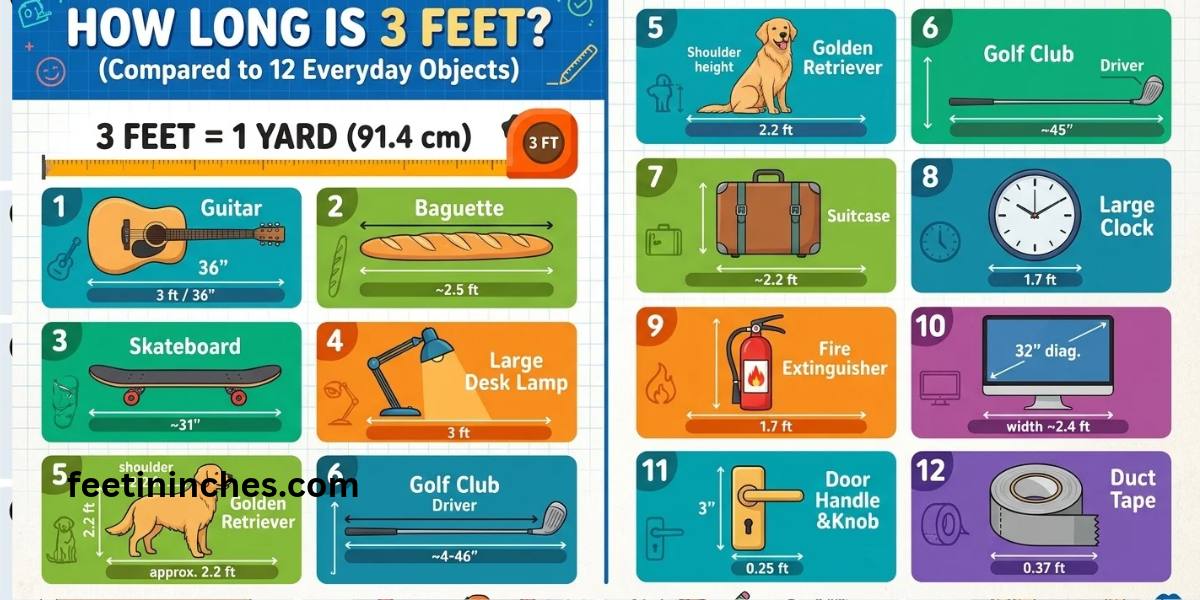
How long is 3 feet? You might need to know when measuring furniture, checking a room’s dimensions, buying a household item, or estimating the length of something without a measuring tape.
Three feet may sound like a short distance, but it is longer than many people imagine. It is the same length as one yard and measures exactly 36 inches. In metric units, it equals 91.44 centimeters or 0.9144 meters. These conversions follow the standard measurements published by the National Institute of Standards and Technology (NIST).
The easiest way to understand this measurement is to compare it with familiar objects. A standard yardstick, a large guitar, or three rulers placed end to end can help you picture the distance. Some objects will be close to three feet, while others will vary by model or design.
In this guide, you will learn how long 3 feet is, explore 12 everyday comparisons, and discover practical ways to estimate the measurement. You will also find a conversion table, measuring tips, common mistakes, and answers to frequently asked questions.
How Long Is 3 Feet in Inches, Centimeters, and Meters?
Three feet equals 36 inches, 91.44 centimeters, or 0.9144 meters. It is also exactly one yard. This makes three feet a useful measurement for furniture, home improvement, school projects, and everyday size comparisons.
Here is the basic conversion:
| Unit | Equivalent |
|---|---|
| Feet | 3 feet |
| Inches | 36 inches |
| Yards | 1 yard |
| Centimeters | 91.44 cm |
| Meters | 0.9144 m |
| Millimeters | 914.4 mm |
The calculations are straightforward.
-
Feet to inches: Multiply 3 by 12 to get 36 inches.
-
Feet to centimeters: Multiply 3 by 30.48 to get 91.44 centimeters.
-
Feet to meters: Multiply 3 by 0.3048 to get 0.9144 meters.
-
Feet to yards: Divide 3 by 3 to get 1 yard.
These are exact conversions, not estimates. The size of an everyday object, however, may differ from its typical description.
Is 3 feet the same as 1 yard?
Yes. One yard contains exactly three feet, so a three-foot length is precisely one yard. A yardstick provides a convenient physical reference when you need to visualize this distance.
Is 3 feet considered long?
Three feet is a moderate length for a household object. It is longer than a typical ruler but shorter than many dining tables, beds, and full-size doors. Whether it seems long depends on what you are measuring.
For a small desk accessory, three feet might feel substantial. For a sofa or a room, it is relatively short.
What Does 3 Feet Look Like in Real Life?
The simplest way to picture three feet is to imagine a straight line stretching from one end of a yardstick to the other. You can also visualize the distance as three 12-inch sections placed together.
Think about a space on your floor that is just under one meter long. That is approximately how much room three feet occupies.
You can estimate this distance by using familiar items, but remember that everyday products do not always have standard dimensions. A guitar, chair, or storage box may be longer or shorter depending on its design.
The following comparisons provide useful visual references. Use them for estimation rather than precise construction work.
12 Everyday Objects That Help You Visualize 3 Feet
Several common objects can help you understand a three-foot length without a measuring tape. The closest matches are a yardstick, three standard rulers placed end to end, and objects with published dimensions near 36 inches. The other comparisons below provide useful estimates, but their sizes can vary.
1. A Standard Yardstick
Length: Exactly 3 feet
A standard yardstick is one of the most reliable comparisons because it is designed to measure one yard. It has markings for inches and usually displays the full 36-inch length.
You might find a yardstick in a classroom, workshop, sewing room, or hardware store. Place it against a wall or along the edge of a table to see the full distance.
Why it helps: Unlike many household objects, a standard yardstick has a clearly defined measurement.
2. Three Standard 12-Inch Rulers
Length: 36 inches when aligned correctly
Most standard school rulers measure 12 inches. Put three of them end to end, and their combined length is three feet.
Make sure the rulers touch without overlapping. Even a small gap between them can affect your estimate.
Why it helps: This is an easy method for students, teachers, and anyone with basic stationery supplies.
3. A Large Acoustic Guitar
Length: Often around 36 to 42 inches overall
A full-size acoustic guitar can provide a useful visual reference for three feet. Many models measure more than 36 inches from the top of the headstock to the bottom of the body.
This makes a guitar a little longer than three feet in many cases. Its exact length depends on the body shape, neck design, and manufacturer.
Why it helps: If you already own a guitar, it offers a familiar object for estimating a length close to three feet. Check the manufacturer’s specifications for a precise comparison.
4. A Small Folding Table
Length: Depends on the table
Some compact folding tables have a side measuring approximately 36 inches. This is common enough to make certain models useful for visualization, although not every folding table has this dimension.
Measure across the shorter or longer side, depending on the direction you want to compare. A table’s width and length are different measurements.
Why it helps: A three-foot table dimension can help when planning a small workspace, temporary serving area, or craft station.
5. A Three-Foot Section of Garden Hose
Length: Exactly 3 feet if measured and marked
A garden hose can be cut or marked to any length. Measure a three-foot section, and you have a practical reference for outdoor tasks.
Unlike a full hose, which may stretch across an entire yard, a short marked section gives you a direct example of the distance.
Why it helps: This comparison is useful for gardening, irrigation layouts, and estimating short distances around flower beds.
6. A Medium-Length Walking Cane
Length: Varies by design and user
Some canes approach three feet in length, while many are shorter. Adjustable models also have different minimum and maximum settings.
A cane can help you picture a vertical measurement, but it should not be treated as a standard three-foot object. Its length is normally chosen for the user’s height and needs.
Why it helps: It provides a familiar comparison for understanding a distance near 36 inches. Always check the product’s specifications before using it as a measuring reference.
7. A Short Section of PVC Pipe
Length: 3 feet when cut to 36 inches
PVC pipe is sold in various lengths and can be cut for plumbing, irrigation, and DIY projects. A three-foot piece gives you a rigid reference that is easy to lay against another surface.
Remember that pipe diameter describes its width, not its length. A pipe with a two-inch diameter can still be three feet long.
Why it helps: This is a practical reference for people planning simple DIY projects or measuring short pipe runs.
8. A Long Skateboard
Length: Often around 28 to 33 inches for a conventional skateboard
A regular skateboard is usually somewhat shorter than three feet. Longboards can be longer and may approach or exceed 36 inches.
This comparison is helpful because the difference is easy to imagine. A conventional skateboard generally falls short of the target, while some longboards come closer.
Why it helps: It gives skateboard owners a familiar starting point for estimating 36 inches.
9. A Compact Floor Lamp
Some compact lamps stand close to three feet tall, although many floor lamps are substantially taller. The shade and base can also affect the overall height.
Compare the full height from the floor to the highest point. Measuring only the lamp’s pole will give you a different result.
Why it helps: A lamp can help you visualize a vertical three-foot distance in a living room, bedroom, or office.
10. A Large Storage Box
Some large storage boxes have a side approaching 36 inches. Many are much shorter, so this is an approximate comparison rather than a standard measurement.
Check the box’s length, width, and height separately. Product descriptions may list these dimensions in a different order.
Why it helps: A storage container can help you plan closet space, garage shelving, or the dimensions of a storage area.
11. A Small Bench
A small entryway bench may be approximately three feet wide, but larger benches can extend much farther.
When comparing a bench with three feet, measure from one end of the seat to the other. Do not confuse its width with its height or depth.
Why it helps: This comparison is useful when deciding whether a bench will fit beside a doorway or beneath a window.
12. A One-Yard Piece of Fabric
Length: 36 inches when measured along the cut length
Fabric is often sold by the yard in places that use customary units. One yard equals three feet, making it an excellent reference for sewing and craft projects.
The fabric’s width is separate from the amount purchased by length. A yard of fabric might be 36 inches long while measuring much more than 36 inches across.
Why it helps: It offers an accurate reference for curtains, clothing projects, quilting, and other sewing tasks.
Comparison Table: Which Objects Are Closest to 3 Feet?
The table below separates exact measurements from approximate comparisons. This matters because an object that looks close to three feet may not measure exactly 36 inches.
| Everyday object | Approximate length | How close is it? |
|---|---|---|
| Standard yardstick | 36 inches | Exact |
| Three 12-inch rulers | 36 inches | Exact when aligned |
| Full-size acoustic guitar | 36–42 inches often | Close or longer |
| Compact folding table | Varies | Check dimensions |
| Marked garden hose section | 36 inches | Exact when measured |
| Walking cane | Varies | Model dependent |
| PVC pipe section | 36 inches when cut | Exact when measured |
| Conventional skateboard | 28–33 inches often | Usually shorter |
| Compact floor lamp | Varies | Model dependent |
| Large storage box | Varies | Check dimensions |
| Small bench | Varies | Some models are close |
| One-yard fabric cut | 36 inches | Exact length |
The approximate ranges in this table are general examples, not manufacturer-wide specifications. Individual products can differ.
The best choices for accurate visualization are the yardstick, three rulers, and a measured three-foot section of hose or pipe. Use furniture and sports equipment only as rough references.
How Can You Measure 3 Feet Without a Measuring Tape?
You do not always need a measuring tape to estimate three feet. A ruler, a marked piece of string, or a known one-yard object can help you measure this distance. For rough household planning, these methods are convenient. For cutting materials or fitting furniture, verify the measurement with a proper measuring tool.
Method 1: Use a 12-Inch Ruler
A standard 12-inch ruler measures one foot.
-
Place the ruler at the starting point.
-
Mark the end of the ruler.
-
Move it forward until its starting edge meets the mark.
-
Repeat the process three times.
You will cover 36 inches in total. Keep the ruler straight to avoid measurement errors.
Method 2: Mark a Piece of String
String can help you measure a short distance around the home.
-
Lay the string flat on a surface.
-
Use a ruler to mark a point 36 inches from one end.
-
Cut or mark the string at that point.
-
Stretch it between the two points you want to compare.
This works well for rough planning. String can stretch, bend, or sag, so avoid using it for tasks that require precision.
Method 3: Use a Yardstick
A standard yardstick already measures one yard, which equals three feet. Place it along the surface you want to measure and check whether the entire length fits.
This is often faster than measuring three separate sections with a shorter ruler.
Method 4: Use a Smartphone Measuring App
Some smartphones include measurement tools that use the camera to estimate distances. Apple’s Measure app is one example for supported iPhone models.
These apps can be convenient for quick estimates, but their accuracy depends on the device, lighting, camera view, and surroundings. Do not rely on a phone app alone when cutting wood, installing cabinets, or making safety-critical measurements.
Method 5: Convert Meters to Feet
If you have a metric ruler, use the conversion instead. Three feet equals 0.9144 meters, or 91.44 centimeters.
A centimeter ruler can measure this distance by counting to 91.44 centimeters. In practice, you may mark 91.4 centimeters for an ordinary estimate.
Where Is a 3-Foot Measurement Useful?
A three-foot measurement appears in many household and everyday situations. Understanding the distance can help you make better estimates before purchasing materials or rearranging a room.
Furniture and Interior Design
Three feet can help you visualize the width of a small bench, the depth of a compact table, or the clearance around furniture. However, these measurements are not interchangeable.
For example, a table that is 36 inches wide may be only 24 inches deep. Always compare the specific dimension that matters for your room.
Before buying furniture, measure the available floor space. Also check whether doors, drawers, and chairs can open or move without obstruction.
Gardening and Outdoor Projects
Gardeners may use three-foot sections when arranging planters, marking garden beds, or estimating short hose runs.
A marked three-foot length can also help you compare the spacing between objects. However, plant spacing should follow the needs of each species rather than a general measurement rule.
For outdoor projects, use a durable measuring tape if the ground is uneven or the distance must remain consistent.
DIY and Home Improvement
A three-foot length can help you plan shelves, work surfaces, trim pieces, and short sections of pipe. But an approximate comparison is not enough when you need parts to fit together.
Measure the actual installation area before cutting materials. Account for brackets, joints, wall irregularities, and the thickness of materials.
A simple rule helps prevent wasted supplies. Estimate first, measure twice, and cut only after confirming the dimensions.
School and Educational Projects
Three feet provides a useful way to teach measurement conversions. Students can compare a yardstick with a meter stick and learn that one yard is slightly shorter than one meter.
This example also shows why conversions matter. One yard is 36 inches, while one meter is approximately 39.37 inches.
Packing and Storage
A three-foot reference can help you estimate whether a long object might fit in a storage area or vehicle. Still, you should check all three dimensions of the available space.
A box that is three feet long may not fit if the doorway is narrower or the interior height is too low.
Common Mistakes When Estimating Three Feet
Even a familiar measurement can cause confusion. These are some common errors to avoid.
Confusing Feet With Inches
Three feet is 36 inches, not 3 inches. Since a foot contains 12 inches, multiply the number of feet by 12 to convert it.
Assuming Every Similar Object Has the Same Size
Two benches can look almost identical but have different lengths. The same applies to guitars, tables, storage boxes, and lamps.
Treat visual comparisons as estimates unless you know the item’s dimensions.
Measuring the Wrong Side
An object has length, width, and height. A three-foot table width does not mean the table is three feet long in every direction.
Check which dimension you need before comparing it with another object.
Ignoring Gaps Between Rulers
Three rulers only give a combined length of 36 inches when each measures 12 inches and their ends meet correctly. Gaps and overlaps change the total distance.
Relying on Memory for Exact Measurements
Your estimate may be good enough to rearrange a room, but it might not be good enough to install a shelf. Use a proper measuring tool whenever accuracy matters.
Why Accurate Measurements Matter
A small measurement error can create an inconvenient result. A shelf may not fit, a piece of fabric may come up short, or a table may block a walkway.
For everyday estimates, familiar objects are useful because they help you develop a sense of scale. For purchases and construction, exact measurements reduce uncertainty.
Keep these principles in mind:
-
Use familiar objects to visualize a distance.
-
Check product specifications when dimensions matter.
-
Convert units before comparing measurements from different sources.
-
Measure the actual space before buying or cutting materials.
-
Recheck important measurements before making a final decision.
A three-foot length is simple to understand once you have a reliable reference. The goal is not to memorize every object’s size. It is to know when an estimate is enough and when precision matters.
Frequently Asked Questions About 3 Feet
1. How long is 3 feet exactly?
Three feet is exactly 36 inches, 91.44 centimeters, or 0.9144 meters. It is also equal to one yard.
2. Is 3 feet the same as 36 inches?
Yes. One foot contains 12 inches. Therefore, three feet equals \(3 \times 12 = 36\) inches.
3. Is 3 feet close to 1 meter?
Yes. Three feet equals 0.9144 meters. One meter is approximately 3.28 feet, so three feet is 8.56 centimeters shorter than one meter.
4. What common object is exactly 3 feet long?
A standard yardstick measures exactly 3 feet. Three standard 12-inch rulers placed end to end also measure 3 feet, provided they align without gaps or overlaps.
5. How tall is 3 feet in inches?
Three feet is 36 inches tall. This measurement can describe the height of an object, but it does not indicate the height of a person or item unless that height has been measured.
6. How many centimeters are in 3 feet?
Three feet equals 91.44 centimeters. Multiply the number of feet by 30.48 to convert feet into centimeters.
7. How many meters are in 3 feet?
Three feet equals 0.9144 meters. For a rough everyday estimate, you can round this to approximately 0.91 meters.
8. Is a guitar 3 feet long?
Many full-size acoustic guitars measure around 36 to 42 inches overall. Some are close to three feet, while others are longer. Check the manufacturer’s dimensions for an accurate measurement.
9. Can I measure 3 feet without a tape measure?
Yes. You can use a yardstick, three 12-inch rulers, or a piece of string marked at 36 inches. These methods work well for estimates and basic household tasks.
10. Is 3 feet longer than a skateboard?
A conventional skateboard is often around 28 to 33 inches long, making it shorter than three feet. Some longboards approach or exceed 36 inches.
11. How can I remember the length of 3 feet?
Remember that three feet equals one yard. A yardstick is a convenient reference, and three 12-inch sections provide another easy way to visualize the distance.
12. Is 3 feet a good measurement for furniture?
Three feet can describe the width, depth, or height of certain furniture pieces. Whether it suits your space depends on the furniture design and the available room. Measure the actual item before purchasing it.
Conclusion
So, how long is 3 feet? It measures exactly 36 inches, 91.44 centimeters, or 0.9144 meters. It is also equal to one yard, making a standard yardstick one of the easiest ways to visualize the distance.
You can compare three feet with familiar objects such as a full-size guitar, a compact bench, or three rulers placed end to end. Remember that most household objects vary in size, so they are useful for estimates rather than exact measurements.
For the most reliable reference, use a yardstick or a measuring tape. If you are planning a DIY project, buying furniture, or measuring a space, confirm the dimensions before making a decision.
Which everyday object helps you visualize three feet most easily? Comparing familiar items is a simple way to build a better understanding of measurements and make everyday estimating easier.
Leave a Reply