
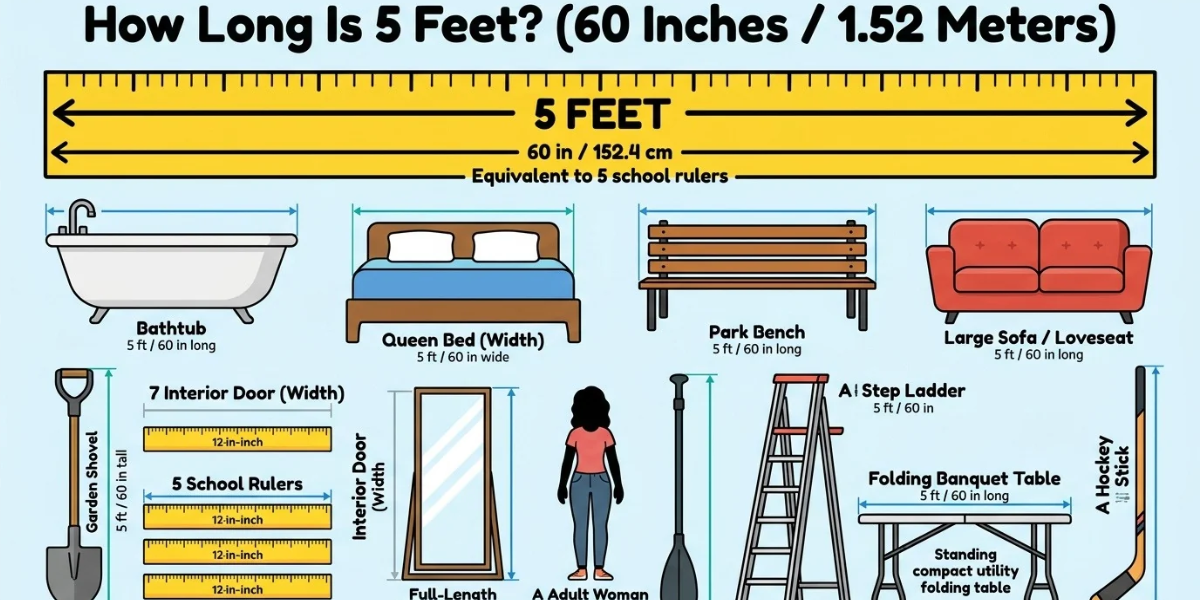
Five feet might sound like a simple measurement. But understanding its actual length can be surprisingly difficult without a familiar object nearby.
Imagine measuring a room, choosing a piece of furniture, or checking whether something will fit inside your home. You might see a measurement of 5 feet and wonder how much space it really takes.
Is it as long as a dining table? Is it close to the height of an adult? Could you compare it with a television or a mattress?
The easiest way to understand five feet is to compare it with objects you already recognize. These comparisons turn an abstract measurement into something you can picture.
In this guide, we’ll explore 12 everyday objects that help you visualize 5 feet. You’ll discover their approximate dimensions, learn which comparisons are closest, and find simple ways to measure five feet without a measuring tape.
Whether you’re planning a home project, shopping online, or simply curious about measurements, this guide will help you understand the length clearly.
Quick Answer: How Long Is 5 Feet?
Five feet is exactly 60 inches, 152.4 centimeters, or 1.524 meters. It is equal to five standard 12-inch rulers placed end to end. You can visualize this length using a queen mattress’s width, a 60-inch television’s diagonal, or a five-foot folding table.
Here are the most useful conversions:
| Measurement Unit | Equivalent |
|---|---|
| Feet | 5 feet |
| Inches | 60 inches |
| Centimeters | 152.4 cm |
| Meters | 1.524 m |
| Millimeters | 1,524 mm |
| Yards | 1.67 yards |
| Kilometers | 0.001524 km |
Five feet is also half of 10 feet and one-third of 15 feet.
A simple way to remember it is this: five feet equals 60 inches. Once you remember that conversion, comparing other objects becomes much easier.
12 Everyday Objects That Help You Visualize 5 Feet
Several familiar objects have dimensions close to 60 inches. Some provide an exact five-foot measurement, while others offer approximate comparisons.
The distinction matters because product dimensions can change between manufacturers and models.
Let’s explore twelve useful examples.
1. A Queen Mattress Is 5 Feet Wide
A queen mattress is one of the easiest ways to visualize five feet.
A standard queen mattress in the United States measures approximately 60 inches wide and 80 inches long. That means its width is exactly five feet.
This makes it a practical comparison because most people recognize the size of a queen bed.
The mattress is designed to provide sleeping space for two adults. Its five-foot width creates a useful reference for room planning.
You can find queen mattresses in different materials and designs, including:
- Memory foam mattresses
- Innerspring mattresses
- Hybrid mattresses
- Latex mattresses
- Pillow-top mattresses
The standard width remains 60 inches, although actual product dimensions can have small manufacturing variations.
How to Visualize 5 Feet
Look across the shorter side of a queen mattress. That distance represents approximately five feet.
Imagine standing beside the mattress and stretching your arms across its width. This gives you a useful mental picture of the measurement.
Interesting fact: A queen mattress is 20 inches longer than its width. Its full dimensions are approximately 60 by 80 inches.
2. A 60-Inch Television Measures 5 Feet Diagonally
A 60-inch television provides another recognizable comparison.
Television screen sizes are measured diagonally. This means a 60-inch TV has a diagonal screen measurement of five feet.
However, its width is not 60 inches.
A standard widescreen television with a 16:9 aspect ratio has an approximate screen width of 52.3 inches. Its height is about 29.4 inches.
The diagonal connects the two opposite corners of the display.
You may find televisions with this screen size from brands such as:
- Samsung
- LG
- Sony
- TCL
- Hisense
Their screen dimensions can vary slightly depending on the design and aspect ratio.
Why Is the Diagonal Important?
Many shoppers misunderstand television measurements.
A person might see a 60-inch television and assume it is five feet wide. That is incorrect.
The measurement refers to the diagonal distance, not the horizontal width.
For example, a 60-inch television usually needs considerably less than five feet of horizontal space. Its frame and stand may also affect its overall dimensions.
Remember: A 60-inch television is five feet diagonally, not five feet wide.
3. A Five-Foot Folding Table
A five-foot folding table is a direct example of this measurement.
Many folding tables are available in lengths around 60 inches. These tables are commonly used at family gatherings, outdoor events, markets, and temporary workspaces.
Their practical design makes them easy to recognize.
You might see a five-foot table used for:
- Family dinners
- Birthday celebrations
- School events
- Small exhibitions
- Outdoor picnics
- Home projects
Some models have plastic tops with metal legs. Others feature wooden or composite surfaces.
How Much Space Does It Take?
A 60-inch table occupies five feet along its longest side.
Its width depends on the specific design. Many rectangular folding tables have widths around 24 to 30 inches.
If you’re arranging chairs around one, remember to leave additional room for people to sit comfortably.
A five-foot table is a useful example when planning a small dining area or event space.
4. A Five-Foot Curtain Panel
Curtains provide another helpful way to understand five feet.
Some curtain panels measure 60 inches in length. That equals exactly five feet.
You may find this size in shorter window treatments, decorative curtains, and certain kitchen or bedroom designs.
Curtains are available in many different lengths, including:
- 45 inches
- 54 inches
- 60 inches
- 63 inches
- 72 inches
- 84 inches
- 96 inches
A 60-inch curtain panel is five feet long when measured from its top edge to its bottom edge.
Where Are Five-Foot Curtains Used?
They may work well for shorter windows or decorative arrangements. However, the correct curtain length depends on the window and the desired appearance.
Some people prefer curtains that stop near the windowsill. Others prefer panels that reach the floor.
Before purchasing curtains, measure the window and decide where you want the fabric to finish.
Helpful tip: Check whether the advertised length includes the curtain header or hanging attachments. Product descriptions can use different measurement methods.
5. A Five-Foot Fishing Rod
Fishing rods are commonly sold according to their overall length.
A five-foot fishing rod measures 60 inches from its butt end to its tip when fully assembled.
This is a useful comparison because fishing rods come in many different lengths.
Shorter rods can be suitable for certain confined fishing environments. Longer rods can provide additional casting distance in suitable conditions.
A five-foot rod may be used for:
- Small streams
- Compact fishing areas
- Certain freshwater applications
- Beginner fishing setups
- Specific ultralight fishing techniques
The best rod length depends on the fishing location, target species, and equipment.
How to Picture Its Length
Imagine a fishing rod extending along the floor. Its full assembled length covers five feet.
The rod is usually much longer than it appears when stored. Some models separate into multiple sections for transport.
When comparing fishing rods, check the assembled length rather than the length of the individual sections.
6. A Five-Foot Bookshelf
A bookshelf measuring 60 inches in height or width can provide a practical five-foot reference.
Bookshelves come in many sizes. Some are short and wide, while others are tall and narrow.
A five-foot bookshelf is a common size choice for homes, offices, and study rooms.
It can hold different types of items, such as:
- Novels and textbooks
- Photo frames
- Storage baskets
- Decorative objects
- Office supplies
- Small plants
Height or Width?
This distinction is important.
A bookshelf measuring five feet tall has a vertical dimension of 60 inches. A bookshelf measuring five feet wide has a horizontal dimension of 60 inches.
These are two different ways to use the same measurement.
Before buying a bookshelf, check its height, width, and depth separately.
Also consider ceiling clearance, available wall space, and the room’s furniture arrangement.
A five-foot bookshelf is particularly useful for understanding how much vertical or horizontal space 60 inches occupies.
7. A Five-Foot Floor Lamp
Some floor lamps stand approximately five feet tall.
These lamps are common in living rooms, bedrooms, reading corners, and home offices.
A 60-inch floor lamp reaches five feet from the floor to its highest point.
Its overall height depends on the design and shade.
Common floor lamp styles include:
- Traditional standing lamps
- Arc floor lamps
- Tripod lamps
- Reading lamps
- Adjustable floor lamps
Some models have narrow bases and tall poles. Others use wider shades or curved arms.
How Does Five Feet Look in a Room?
Imagine a floor lamp standing beside a sofa.
A five-foot lamp is tall enough to provide lighting above many seating arrangements. However, the exact position of its shade depends on its design.
It is a useful comparison when planning furniture placement or choosing lighting for a room.
One important detail: a lamp’s advertised height may include its shade or exclude certain adjustable parts. Always review the product specifications.
8. A Five-Foot Fence Panel
Fence panels provide another practical comparison.
Some garden fence panels are manufactured with a height of 60 inches. This equals five feet.
They can be used around residential gardens, outdoor spaces, and selected property boundaries.
Fence panels are available in different materials, including:
- Wood
- Vinyl
- Metal
- Composite materials
- Decorative plastic
A five-foot panel provides a clear reference for understanding vertical measurements.
Where Might You See One?
You might find a five-foot fence panel around a backyard or garden.
Its actual appearance depends on the design. Some panels have closely spaced boards, while others feature open decorative patterns.
When planning a fence, remember that the panel height is not always the final installed height.
Posts, ground clearance, and installation methods can change the overall measurement.
For accurate planning, measure from the finished ground level to the highest point of the installed fence.
9. A Five-Foot Area Rug
Area rugs are often sold using standard dimensions.
A 5-by-7-foot rug has one side measuring exactly five feet. Its other side measures seven feet.
This provides a convenient comparison for understanding 60 inches.
The five-foot side is equal to 60 inches, while the seven-foot side equals 84 inches.
These rugs are commonly used in:
- Living rooms
- Bedrooms
- Dining spaces
- Home offices
- Small sitting areas
How Much Floor Space Does It Cover?
A five-by-seven-foot rug covers 35 square feet.
This is different from measuring a five-foot length. The five-foot side describes one dimension, while the total floor coverage depends on both dimensions.
A rug can help you visualize five feet across a horizontal surface.
Before buying one, measure your room and consider where the furniture legs will sit.
A good rug should fit the furniture arrangement rather than simply fill the available floor space.
10. A Five-Foot Garden Stake
Garden stakes are used to support plants and guide their growth.
Some garden stakes are sold in lengths of 60 inches. That makes them exactly five feet long.
They may be made from:
- Bamboo
- Wood
- Fiberglass
- Metal
- Plastic-coated steel
Gardeners use stakes to support climbing plants, young trees, vegetables, and decorative flowers.
Why Does a Five-Foot Stake Matter?
The length gives you an idea of how much support you can provide above ground.
However, the entire stake may not remain visible. Some of it usually enters the soil.
For example, if a 60-inch stake is inserted 12 inches into the ground, approximately 48 inches remain above the soil.
That is four feet of visible support.
This example shows why installation depth matters when measuring outdoor objects.
A five-foot garden stake is a practical reference for anyone planning a garden or outdoor project.
11. A Five-Foot Mirror
Full-length mirrors are available in many different heights.
Some models measure around 60 inches tall. This makes them five feet high.
These mirrors are often used in bedrooms, dressing areas, hallways, and clothing stores.
Common mirror styles include:
- Wall-mounted mirrors
- Leaning floor mirrors
- Framed mirrors
- Frameless mirrors
- Decorative standing mirrors
A five-foot mirror can provide a useful reflection for many people. However, the visible reflection also depends on the person’s height and the mirror’s position.
How to Visualize It
Imagine a mirror standing vertically against a bedroom wall.
Its top edge reaches five feet above its bottom edge.
Some mirrors are taller, while others are shorter. Therefore, check the listed height before using one as a precise comparison.
A five-foot mirror is especially useful when planning a dressing space or choosing a decorative wall feature.
12. A Standard Table Tennis Table Is About Five Feet Wide
A regulation table tennis table offers one of the most interesting comparisons.
According to standard international table tennis dimensions, the playing surface measures approximately 2.74 meters long and 1.525 meters wide.
That width is approximately 60.04 inches, or almost exactly five feet.
In other words, a regulation table tennis table is just slightly wider than five feet.
It is a recognizable object found in:
- Recreation centers
- Sports clubs
- Schools
- Community halls
- Homes
Why Is This a Useful Comparison?
The table is large enough to make the measurement easy to visualize.
Its width represents almost five feet, while its full length measures nine feet.
This comparison also demonstrates why exact conversions matter.
Five feet equals 152.4 centimeters. The official table width is 152.5 centimeters. The difference is only 0.1 centimeter.
That makes a regulation table tennis table an excellent near-exact five-foot reference.
Quick Comparison Table: 12 Objects That Help You Understand 5 Feet
Here is a summary of the objects discussed above.
| Everyday Object | Relevant Dimension | Comparison |
|---|---|---|
| Queen mattress | 60 inches wide | Exactly 5 feet |
| 60-inch TV | 60 inches diagonally | Exactly 5 feet |
| Folding table | 60 inches long | 5 feet |
| Curtain panel | 60 inches long | 5 feet |
| Fishing rod | 60 inches long | 5 feet |
| Bookshelf | 60 inches tall or wide | 5 feet |
| Floor lamp | 60 inches tall | 5 feet |
| Fence panel | 60 inches tall | 5 feet |
| Area rug | 5 feet on one side | Exactly 5 feet |
| Garden stake | 60 inches long | 5 feet |
| Full-length mirror | 60 inches tall | 5 feet |
| Table tennis table | 60.04 inches wide | Almost 5 feet |
Important: Several examples describe common product specifications or possible product dimensions. Not every folding table, curtain, lamp, or mirror measures five feet. Check the individual product before relying on its size.
How Tall Is 5 Feet Compared to a Person?
Five feet is also a useful human-height reference.
A person who measures exactly five feet tall has a height of 60 inches or 152.4 centimeters.
Human height varies widely. Some adults are shorter than five feet, while many are taller.
A person’s height is measured from the bottom of their feet to the top of their head while standing upright.
How Does Five Feet Look?
Imagine a person standing beside a standard interior doorway.
A typical interior door is around 80 inches tall. A five-foot person would stand 20 inches below its top edge.
This makes the measurement easier to picture.
You can also compare five feet with a kitchen counter or a tall piece of furniture. These comparisons are useful, although their actual dimensions vary.
How Many Inches Are in 5 Feet?
There are exactly 60 inches in five feet.
The conversion is simple because one foot contains 12 inches.
Here is the calculation:
5 × 12 = 60 inches
You can use the same formula for any feet-to-inches conversion.
For example:
| Feet | Inches |
|---|---|
| 1 foot | 12 inches |
| 2 feet | 24 inches |
| 3 feet | 36 inches |
| 4 feet | 48 inches |
| 5 feet | 60 inches |
| 6 feet | 72 inches |
| 7 feet | 84 inches |
| 8 feet | 96 inches |
| 9 feet | 108 inches |
| 10 feet | 120 inches |
This conversion is particularly helpful when measuring furniture, rooms, and household objects.
How Many Centimeters Is 5 Feet?
Five feet equals exactly 152.4 centimeters.
To convert feet into centimeters, multiply the number of feet by 30.48.
For five feet:
5 × 30.48 = 152.4 centimeters
This is useful when reading metric product specifications.
For example, a furniture listing may describe a table as 152.4 centimeters long instead of 60 inches.
Both measurements describe the same length.
You can also convert five feet into millimeters:
152.4 × 10 = 1,524 millimeters.
How Can You Measure 5 Feet Without a Measuring Tape?
You do not always need a specialized measuring tool.
Several simple methods can help you estimate five feet.
1. Use a Standard Ruler
A standard 12-inch ruler measures one foot.
Place five rulers end to end.
The combined length will equal 60 inches, or five feet.
This is a reliable method if the rulers have accurate markings.
2. Use a Yardstick
A yardstick measures 36 inches, or three feet.
One yardstick plus another 24 inches equals five feet.
You can use two-thirds of a second yardstick to complete the measurement.
3. Use a Measuring Tape
A measuring tape is usually the easiest household option.
Follow these steps:
- Place the tape’s zero point at one end.
- Extend the tape along a straight line.
- Find the 60-inch marking.
- Keep the tape flat and straight.
- Read the measurement directly above the mark.
For longer distances, avoid letting the tape bend or sag.
4. Use a Digital Measuring Tool
Some laser distance meters can measure longer distances quickly.
Brands such as Bosch, Leica, and DeWalt offer measuring tools for different applications.
A laser distance meter can be helpful when measuring rooms or furniture placement.
However, it may be unnecessary for a simple five-foot measurement. A regular tape measure is often sufficient.
5. Use Your Arm Span as a Rough Estimate
Your arm span may help you estimate five feet.
However, arm spans differ from person to person.
If your fingertip-to-fingertip distance is close to five feet, you can use it as a rough visual guide.
Do not rely on this method for construction, furniture installation, or other tasks requiring accuracy.
Common Mistakes When Measuring Five Feet
Even a simple measurement can become confusing when you overlook a few details.
Here are common mistakes to avoid.
Confusing Feet With Inches
Five feet does not equal five inches.
Five feet equals 60 inches.
This is one of the most important conversions to remember.
Confusing Width With Height
A 60-inch television measures five feet diagonally. Its screen width is smaller.
Similarly, a bookshelf can be five feet tall without being five feet wide.
Always identify the dimension you need.
Ignoring Product Variations
Two products with similar appearances may have different measurements.
A folding table from one manufacturer may measure 60 inches. Another may measure 72 inches.
Always read the product specifications before purchasing.
Measuring Along a Curved Surface
A straight five-foot measurement is not the same as a curved path measuring five feet.
For accurate results, place the measuring tape along the intended measurement line.
Forgetting Installation Space
Furniture and household products may require additional clearance.
A five-foot table needs more than five feet of available room if people must walk around it.
Consider the surrounding space before making a purchase.
Frequently Asked Questions About 5 Feet
1. How long is 5 feet in inches?
Five feet equals exactly 60 inches. Multiply five by 12 because each foot contains 12 inches.
2. How long is 5 feet in centimeters?
Five feet equals 152.4 centimeters. This conversion is useful when comparing imperial and metric measurements.
3. Is 5 feet considered long?
Five feet is a moderate length for many household objects. It is long enough to describe furniture, curtains, mirrors, and some sports equipment.
4. What everyday object is exactly 5 feet long?
A 60-inch folding table, 60-inch curtain panel, or five-foot garden stake can measure exactly five feet. However, you should check the product specifications.
5. Is a queen bed 5 feet wide?
Yes. A standard US queen mattress measures approximately 60 inches wide. That equals exactly five feet.
6. Is a 60-inch TV five feet wide?
No. A 60-inch television measures five feet diagonally. Its horizontal screen width is approximately 52.3 inches for a standard 16:9 display.
7. How tall is 5 feet in meters?
Five feet equals 1.524 meters. You can calculate this by multiplying five by 0.3048.
8. How many millimeters are in 5 feet?
Five feet equals 1,524 millimeters. There are 304.8 millimeters in one foot.
9. Is 5 feet half of 10 feet?
Yes. Five feet is exactly half of 10 feet.
10. How can I visualize five feet without a ruler?
Use the width of a queen mattress, a five-foot table, or the diagonal of a 60-inch television. These familiar references make the length easier to imagine.
11. Is 5 feet the same as 1.5 meters?
Not exactly. Five feet equals 1.524 meters. It is slightly longer than 1.5 meters by 2.4 centimeters.
12. How many steps equal five feet?
There is no fixed number of steps because stride length varies. For many adults, five feet is roughly one or two walking steps.
Final Thoughts: Understanding the Length of 5 Feet
Five feet equals 60 inches, 152.4 centimeters, or 1.524 meters. Although the measurement may seem abstract, familiar household objects make it much easier to understand.
A queen mattress is five feet wide. A 60-inch television measures five feet diagonally. A five-foot folding table, curtain panel, or garden stake can provide a direct comparison.
The most useful approach is to compare the dimension that matters. Always distinguish between an object’s height, width, length, and diagonal.
If you need an accurate measurement, use a measuring tape rather than relying on visual estimates.
The next time you see a measurement of five feet, you can picture it much more clearly.
Leave a Reply