
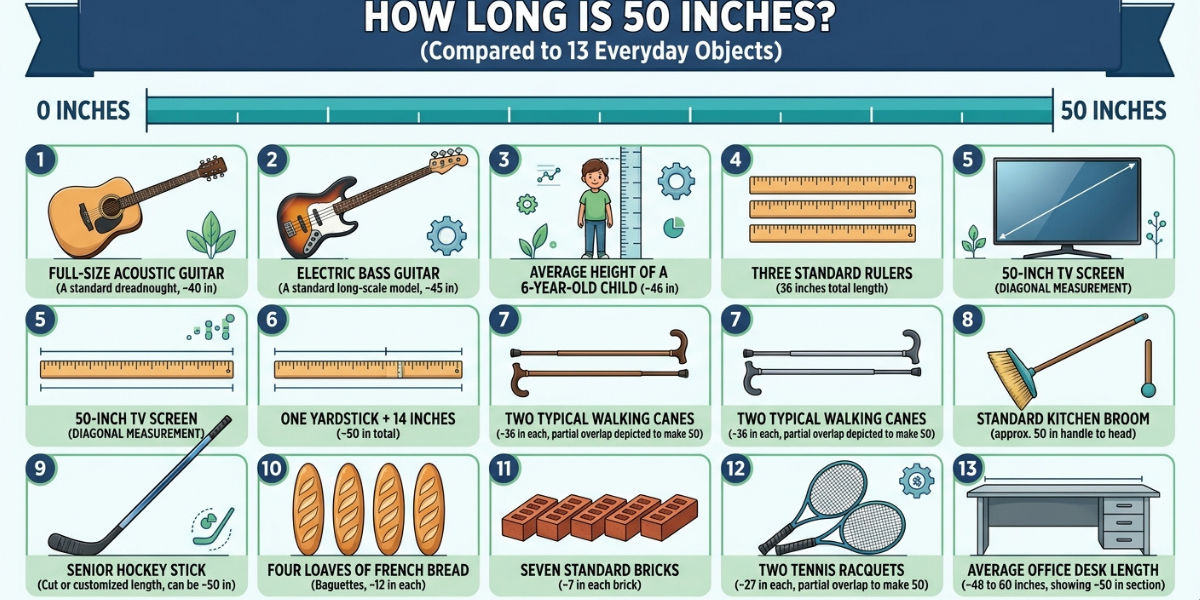
Have you ever wondered how long 50 inches really is? This measurement can be difficult to imagine if you do not have a ruler or measuring tape nearby. However, comparing it with familiar household items, furniture, and everyday objects makes it much easier to understand.
50 inches equals 4 feet and 2 inches, 127 centimeters, or approximately 1.27 meters. It is a little longer than the height of many kitchen countertops and close to the width of some large televisions. It can also be compared with a small dining table, a guitar, or several objects placed together.
Understanding how long 50 inches is can be useful when shopping for furniture, measuring a room, choosing a television, planning a home improvement project, or estimating the size of an object.
In this guide, we will compare 50 inches with 13 everyday objects. You will also learn how to convert 50 inches into feet, centimeters, and meters, along with simple ways to estimate this length without a measuring tape.
How Long Is 50 Inches?
50 inches is a length measurement equal to 4 feet and 2 inches. In the metric system, it is exactly 127 centimeters or 1.27 meters.
The easiest way to picture this length is to imagine a line measuring 4 feet, followed by another 2 inches.
Here are the basic conversions for 50 inches.
| Measurement Unit | Equivalent |
|---|---|
| Inches | 50 inches |
| Feet | 4.167 feet |
| Feet and inches | 4 feet 2 inches |
| Centimeters | 127 cm |
| Meters | 1.27 m |
| Millimeters | 1,270 mm |
| Yards | Approximately 1.389 yards |
These conversions help you understand the same measurement using different units.
For example, if a furniture listing gives a width of 127 centimeters, that measurement is equivalent to 50 inches. Similarly, a space measuring 4 feet and 2 inches is exactly 50 inches long.
13 Everyday Objects That Help You Visualize 50 Inches
The following comparisons use common objects and familiar measurements to make 50 inches easier to picture. Actual object sizes vary, so use the stated dimensions as examples rather than universal measurements.
1. A Large Television Screen
A television advertised as a 50-inch TV provides a familiar reference for this measurement.
However, there is an important detail: television screen sizes are measured diagonally, from one corner of the display to the opposite corner. A 50-inch television does not usually measure 50 inches across its width.
A typical 50-inch television with a 16:9 screen has a display width of approximately 43.6 inches and a height of about 24.5 inches, excluding the frame and stand.
This makes it a useful comparison for understanding the measurement, but the diagonal is the key dimension.
Comparison: A 50-inch TV has a screen diagonal of 50 inches, not a horizontal width of 50 inches.
If you are buying a television, check the product’s actual width and height to ensure it fits your entertainment unit or wall space.
2. A Kitchen Countertop Height Plus 14 Inches
Many kitchen countertops are approximately 36 inches high, although the exact height depends on the design and installation.
If you imagine a 36-inch countertop and add another 14 inches, the total would be 50 inches.
Calculation: 36 + 14 = 50 inches.
This comparison helps you visualize the height of an object that reaches above a typical countertop.
For example, imagine a straight vertical line beginning at the floor and extending to a point 50 inches high. It would reach approximately 14 inches above a 36-inch countertop.
Countertop heights vary, so this is a reference point rather than an exact description of every kitchen.
3. Five Standard Rulers Placed End to End
A standard school ruler is often 12 inches long.
If you place four 12-inch rulers end to end, their total length is 48 inches. That is just 2 inches shorter than 50 inches.
To reach exactly 50 inches, you would need four full rulers plus another 2 inches.
Calculation: (4 × 12) + 2 = 50 inches.
This is one of the easiest ways to visualize the measurement because many people have used a 12-inch ruler at school or home.
It also demonstrates how smaller measurements combine to create a longer distance.
If you have a ruler nearby, try arranging four ruler lengths in a straight line. The result will give you a close visual reference for 50 inches.
4. A Small Dining Table
Some small dining tables measure approximately 50 inches across their longest side.
A table with this length can provide enough space for several people, depending on its shape, width, and seating arrangement.
Imagine measuring from one end of the tabletop to the other. If the measurement is exactly 50 inches, the table would be 4 feet and 2 inches long.
This comparison is useful when choosing furniture for a dining room, kitchen, apartment, or breakfast area.
However, dining tables come in many different dimensions. Some compact tables are shorter than 50 inches, while larger family tables can be considerably longer.
Always check the product dimensions before purchasing a table to ensure it fits your available space.
5. A Guitar’s Overall Length
Many full-size acoustic guitars measure approximately 38 to 42 inches from the top of the headstock to the bottom of the body.
A 50-inch length is longer than many standard acoustic guitars.
Imagine placing a 40-inch guitar next to a measuring line. You would need another 10 inches to reach 50 inches.
Calculation: 40 + 10 = 50 inches.
This is a useful comparison because guitars are familiar objects, and their size can help you picture a measurement slightly longer than three feet.
Some guitars and other stringed instruments are larger or smaller, so the exact comparison depends on the instrument.
If you own a guitar, measuring its full length can help you understand how close it comes to 50 inches.
6. A Large Suitcase and Extra Space
Large checked suitcases vary considerably in height and overall dimensions. Some are around 28 to 32 inches tall.
Imagine a suitcase measuring 30 inches tall. Adding another 20 inches would create a total of 50 inches.
Calculation: 30 + 20 = 50 inches.
This is a mathematical comparison rather than a claim that a typical suitcase measures 50 inches in any one direction.
It can help you picture the difference between a large piece of luggage and a longer measurement.
If you are comparing suitcase sizes for travel, remember that airlines often calculate baggage dimensions by adding length, width, and height. The total external dimensions may also include wheels and handles.
7. A Child’s Height
Children grow at different rates, so their heights vary depending on age and individual development.
A child who measures exactly 50 inches tall would be 4 feet and 2 inches tall.
This provides a direct way to picture the measurement because height is often measured in inches during childhood health checks and growth tracking.
Imagine a vertical line from the floor to a point 50 inches high. That is the same height as a person measuring 50 inches.
This comparison is useful for understanding the height of a child, a piece of furniture, or an object placed vertically.
Remember that a person’s height does not describe the length of an object laid horizontally. The measurement is the same, but its orientation is different.
8. A Standard Interior Door’s Width and Height Reference
Many standard interior doors are approximately 80 inches tall, although door sizes vary by building and region.
A 50-inch measurement is 30 inches shorter than an 80-inch door height.
Calculation: 80 − 50 = 30 inches.
Imagine measuring 50 inches upward from the bottom of a typical 80-inch door. You would reach a point 30 inches below the top.
This comparison is useful when estimating the height of a cabinet, storage unit, or other object in a room.
Door heights and widths differ, so check the actual dimensions of your door if you need a precise comparison.
9. A Medium-Sized Desk Width
Some compact desks measure around 40 to 48 inches wide. Others are 50 inches wide or larger.
A desk that measures exactly 50 inches across would provide a direct comparison for this length.
Imagine sitting in front of the desk and looking from its left edge to its right edge. The distance would be 50 inches, or 4 feet and 2 inches.
This is useful when planning a home office, study area, or workstation.
A 50-inch desk can offer space for a monitor, keyboard, notebook, and other supplies, depending on its depth and layout.
Before purchasing one, measure your room and consider the additional space needed for a chair and comfortable movement.
10. A Long Skateboard and Extra Length
Many standard skateboards measure approximately 28 to 33 inches long.
A skateboard measuring 30 inches would be 20 inches shorter than 50 inches.
Calculation: 30 + 20 = 50 inches.
This comparison helps you picture a 50-inch measurement by using a familiar sporting item.
Imagine a 30-inch skateboard placed at one end of a line. You would need another 20 inches to reach the full 50-inch length.
Longboards and other specialty boards can be longer than ordinary skateboards, so their dimensions should be checked separately.
This example is particularly helpful for visualizing the difference between a compact object and a measurement exceeding four feet.
11. Two Guitar Cases Placed End to End
Many guitar cases are approximately 40 to 45 inches long, depending on the type of guitar they are designed to hold.
Two full-size guitar cases placed end to end would usually measure far more than 50 inches. A better way to use them as a reference is to compare a 50-inch line with a single case measuring about 40 inches.
You would need another 10 inches to reach 50 inches.
Calculation: 40 + 10 = 50 inches.
This comparison can help musicians visualize the size of a long object when considering storage space, instrument transport, or shelving.
Guitar cases come in different shapes and sizes, so use the actual external dimensions when planning storage.
12. A Long Wall Shelf
Wall shelves are available in many lengths, including 24, 36, 48, and 60 inches.
A 48-inch shelf is 2 inches shorter than 50 inches.
Calculation: 48 + 2 = 50 inches.
Imagine a four-foot shelf mounted on a wall. Extending the measurement by another 2 inches would give you 50 inches.
This is a particularly useful comparison for home organization, bookshelves, decorative displays, and storage projects.
A shelf measuring 50 inches long may be suitable for books, framed photographs, or small decorative items, depending on its depth and weight capacity.
Always check the shelf’s supported load and installation requirements before placing heavy objects on it.
13. A Straight Path Measuring 1.27 Meters
If you are more familiar with the metric system, a straight line measuring 1.27 meters is exactly 50 inches.
One meter equals 100 centimeters, so 1.27 meters is the same as 127 centimeters.
Imagine measuring a straight path from one point to another. If the distance is 127 centimeters, you have measured 50 inches.
Calculation: 50 × 2.54 = 127 centimeters.
This comparison is especially useful for people who use centimeters and meters for furniture, clothing, household items, and building measurements.
It also provides a precise reference because the conversion does not depend on the approximate dimensions of an everyday object.
Quick Comparison Table: How Long Is 50 Inches?
Here is a summary of the measurements and comparisons discussed above.
| Object or Reference | Measurement | Comparison With 50 Inches |
|---|---|---|
| 50-inch television | 50-inch diagonal | Equal diagonally |
| Kitchen countertop | 36 inches high | 14 inches shorter |
| Four 12-inch rulers | 48 inches | 2 inches shorter |
| Small dining table | 50 inches | Equal if specified |
| Acoustic guitar | About 40 inches | About 10 inches shorter |
| Large suitcase | About 30 inches tall | About 20 inches shorter |
| Child’s height | 50 inches | Equal if specified |
| Interior door | About 80 inches tall | 30 inches taller |
| Compact desk | 50 inches wide | Equal if specified |
| Skateboard | About 30 inches | About 20 inches shorter |
| Guitar case | About 40 inches | About 10 inches shorter |
| Wall shelf | 48 inches | 2 inches shorter |
| Metric measurement | 127 centimeters | Exactly equal |
The dimensions of real objects vary. The table uses approximate sizes or explicitly stated measurements to help visualize 50 inches.
How Long Is 50 Inches Compared With a Person?
50 inches equals 4 feet and 2 inches.
This means a person who is exactly 50 inches tall measures the same distance from the floor to the top of their head.
For an adult, 50 inches is much shorter than typical adult height. For a child, it may be a familiar height depending on age and growth.
You can visualize the measurement by marking a point 50 inches above the floor on a wall. Measuring upward 4 feet gets you to 48 inches. Add another 2 inches to reach the exact point.
This method is more reliable than estimating the height from a person’s appearance.
If you are measuring someone’s height, have them stand upright on a level surface without shoes and use an appropriate measuring method.
How Big Is 50 Inches in Feet?
50 inches equals 4 feet and 2 inches.
There are 12 inches in each foot, so divide 50 by 12.
50 ÷ 12 = 4 feet with 2 inches remaining.
In decimal form, 50 inches is approximately 4.167 feet.
The two formats mean the same thing, but they are used in different situations.
- Feet and inches: 4 feet 2 inches.
- Decimal feet: Approximately 4.167 feet.
Feet and inches are common in everyday descriptions, while decimal feet can be useful for calculations and some technical measurements.
How to Measure 50 Inches Without a Measuring Tape
You can estimate 50 inches using objects you already have at home. These methods are helpful when you need a quick reference.
Method 1: Use a 12-Inch Ruler
Place four 12-inch rulers end to end. Their combined length is 48 inches.
Add another 2 inches to reach 50 inches.
This is a straightforward way to visualize the measurement if you have a standard ruler.
Method 2: Use a Measuring App
Some smartphones include measurement applications that use the camera and sensors to estimate distances.
The accuracy depends on the device, software, lighting, and the object being measured. Check the result against a ruler or tape if precision matters.
Method 3: Compare It With a Known Object
If you know that a shelf is 48 inches long, 50 inches is only 2 inches longer.
Similarly, a 40-inch object would need another 10 inches to reach 50 inches.
Using a known measurement is generally more dependable than guessing the size of an unfamiliar object.
Method 4: Use a Tape Measure in Feet and Inches
If you have a tape measure marked in feet and inches, measure 4 feet first.
Four feet equals 48 inches. Continue another 2 inches to reach 50 inches.
This is useful for checking furniture, shelf dimensions, room layouts, and household projects.
Why Is Understanding 50 Inches Useful?
Knowing how long 50 inches is can help in several everyday situations.
Furniture shopping: Check whether a desk, table, shelf, or storage unit fits your available space.
Television shopping: Understand the difference between a television’s diagonal screen size and its actual width.
Home improvement: Estimate shelf lengths, cabinet dimensions, and other household measurements.
Room planning: Work out whether an object can fit along a wall or inside a particular space.
School and education: Practice converting inches to feet, centimeters, and meters.
General estimation: Compare an unfamiliar length with objects whose dimensions you already know.
Whenever space is limited, remember to measure the available area as well as the object itself. A product may fit along a wall but still leave insufficient room for doors, drawers, or movement.
Frequently Asked Questions
1. How long is 50 inches in feet?
50 inches equals 4 feet and 2 inches, or approximately 4.167 feet in decimal form.
2. How many centimeters are in 50 inches?
50 inches equals exactly 127 centimeters.
Calculation: 50 × 2.54 = 127 cm.
3. How many meters are in 50 inches?
50 inches equals 1.27 meters.
Calculation: 127 ÷ 100 = 1.27 meters.
4. Is 50 inches longer than 4 feet?
Yes. Four feet equals 48 inches, so 50 inches is 2 inches longer than 4 feet.
5. How many feet and inches is 50 inches?
50 inches is 4 feet and 2 inches.
6. Is a 50-inch television 50 inches wide?
No. Television screen sizes are measured diagonally. A typical 50-inch, 16:9 television has a screen width of approximately 43.6 inches, excluding the frame.
7. What household items are about 50 inches long?
A small dining table, some desks, certain shelves, and other furniture may measure around 50 inches. Actual dimensions depend on the specific product.
8. How can I visualize 50 inches without a ruler?
Imagine four 12-inch rulers placed end to end, then add another 2 inches. This gives you a total length of 50 inches.
9. Is 50 inches the same as 5 feet?
No. Five feet equals 60 inches. Therefore, 50 inches is 10 inches shorter than 5 feet.
10. How many millimeters are in 50 inches?
50 inches equals 1,270 millimeters.
Calculation: 127 centimeters × 10 = 1,270 millimeters.
11. How many yards are in 50 inches?
50 inches equals approximately 1.389 yards because one yard contains 36 inches.
Calculation: 50 ÷ 36 ≈ 1.389 yards.
12. Is 50 inches a good size for a desk?
A 50-inch desk can provide useful workspace for a computer and other items, depending on its depth and layout. Whether it is suitable depends on your room and the equipment you need.
13. What is the easiest way to remember 50 inches?
Remember that 50 inches equals 4 feet and 2 inches, or 127 centimeters. It is also 2 inches longer than a four-foot measurement.
Final Thoughts
So, how long is 50 inches? It is exactly 4 feet and 2 inches, 127 centimeters, or 1.27 meters.
Comparing this length with a 50-inch television’s diagonal, a 48-inch wall shelf, a small dining table, or four standard rulers plus another 2 inches can make the measurement easier to visualize.
These everyday references are useful when planning a room, shopping for furniture, measuring household objects, or learning how different units relate to each other.
Remember that everyday objects vary in size. Use the exact product dimensions whenever you need a reliable measurement.
Once you understand how 50 inches compares with familiar objects, you can estimate this length more confidently without having to start from scratch every time.
Leave a Reply