
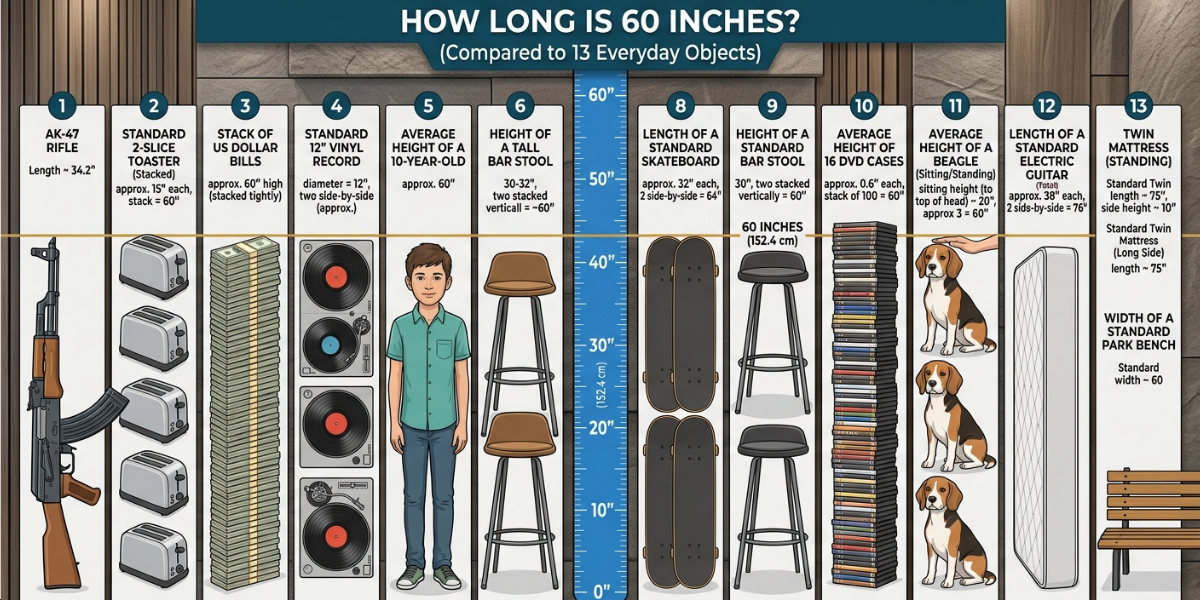
Have you ever wondered how long 60 inches really is? You might see this measurement when shopping for furniture, choosing a television, measuring a table, or planning a home project. However, visualizing 60 inches can be difficult without a familiar object for comparison.
60 inches equals 5 feet, 152.4 centimeters, or 1.524 meters. It is about the height of a short adult, the width of some large televisions, or the length of a small piece of furniture.
The easiest way to understand this measurement is to compare it with everyday objects you already know. These comparisons can help you estimate the length without carrying a measuring tape everywhere.
In this guide, we will explore 13 everyday objects that can help you visualize 60 inches. We will also cover common conversions, practical measuring methods, and frequently asked questions.
How Long Is 60 Inches?
60 inches is equal to exactly 5 feet. Since one foot contains 12 inches, dividing 60 by 12 gives 5 feet.
Here are the most important conversions:
| Measurement | Equivalent |
|---|---|
| Inches | 60 inches |
| Feet | 5 feet |
| Centimeters | 152.4 cm |
| Meters | 1.524 m |
| Millimeters | 1,524 mm |
| Yards | 1.67 yards |
To picture this length, imagine a straight line measuring five feet from one end to the other. It is a little longer than the height of many young children and close to the height of some shorter adults.
Keep in mind that the comparisons below are estimates. Actual object dimensions vary by brand, model, and design.
13 Everyday Objects That Help You Visualize 60 Inches
The following objects provide practical reference points for understanding a length of five feet. Some are close to 60 inches, while others help you estimate the distance by combining smaller measurements.
1. A Standard Kitchen Counter’s Height and Width Reference
Many kitchen countertops stand approximately 36 inches above the floor. That is 3 feet.
If you imagine stacking another 24 inches above that height, you would reach 60 inches.
This comparison is useful when planning kitchen layouts or measuring space around cabinets. However, countertop height is not the same as countertop length, which can vary considerably.
Quick comparison: A typical 36-inch counter height is 24 inches shorter than 60 inches.
2. A Large Television’s Screen Width
Some large televisions have screen widths close to 60 inches, although the actual width depends on the diagonal screen size and aspect ratio.
For example, a television advertised as 60 inches usually has a diagonal screen measurement of 60 inches. Its actual width is shorter, commonly around 52 inches for a widescreen 16:9 display.
This distinction matters when choosing a television for a wall or entertainment unit.
If you need to visualize 60 inches, a 60-inch diagonal television is a useful reference, but do not assume its screen is 60 inches wide.
3. A Five-Foot Measuring Tape
A measuring tape marked in inches offers one of the most accurate ways to picture this distance.
Extend it to the 60-inch mark, and you will see a length equal to five feet.
If you only have a 12-inch ruler, you can measure the same distance by marking five consecutive one-foot sections. Make sure the sections meet accurately without gaps or overlaps.
This method is particularly useful for measuring furniture, shelves, and small home improvement projects.
4. A Short Adult’s Height
Some adults are approximately 60 inches tall, which equals five feet. Height varies widely among individuals, so this is a reference rather than a universal average.
Imagine a person who stands exactly five feet tall. The distance from the floor to the top of their head would be 60 inches.
This example is easy to visualize because most people have seen someone of approximately this height.
Remember that height is a vertical measurement, while the length of an object is usually measured horizontally.
5. A Small Dining Table
Some compact dining tables measure close to 60 inches in length. A five-foot table may accommodate several people, depending on its width, shape, and seating arrangement.
For example, a rectangular table measuring 60 inches long and 30 inches wide is a practical size for many dining spaces.
Not every small dining table measures five feet, so check the product specifications before buying furniture.
6. Five Standard Rulers Placed End to End
A typical school ruler measures 12 inches long.
Place five 12-inch rulers in a straight line, and their combined length will be exactly 60 inches.
The calculation is simple:
12 inches × 5 rulers = 60 inches.
This is one of the easiest ways to visualize five feet at home or in a classroom. If your rulers are shorter or longer than 12 inches, adjust the number accordingly.
7. A Large Sofa Cushion Arrangement
Some sofas have seat cushions that measure around 20 inches across. Three cushions of that width placed side by side would span approximately 60 inches.
For example:
20 inches + 20 inches + 20 inches = 60 inches.
This is a helpful reference when estimating furniture dimensions in a living room. Actual cushion widths vary, and gaps between cushions can affect the total distance.
Use the sofa’s stated dimensions if you need an accurate fit for your room.
8. A Small Bookshelf
Some compact bookshelves measure approximately five feet tall or wide, depending on their design.
A bookshelf that stands 60 inches tall provides a useful vertical comparison. It may have several shelves for books, decorative items, or storage boxes.
However, bookshelves come in many sizes. Some are only two or three feet tall, while larger models may stand well over six feet.
Check the product’s height and width separately when deciding whether it fits your space.
9. Two Golf Clubs and Part of Another
Many golf clubs measure approximately 35–45 inches long, depending on the club type and player specifications.
Two clubs measuring 40 inches each would total 80 inches, which is longer than 60 inches. One 40-inch club plus another 20 inches would give you a five-foot reference.
This comparison demonstrates how familiar sporting equipment can help estimate longer distances, although club lengths vary significantly.
For precise measurements, use the manufacturer’s stated club length.
10. A Large Wall Mirror
Some wall mirrors are approximately 60 inches tall. A mirror measuring five feet in height can make a useful reference when planning a bedroom, hallway, or dressing area.
For example, a mirror measuring 60 inches tall and 24 inches wide would have a height of five feet.
Not all mirrors are this size. Full-length mirrors are available in many heights, so check the dimensions before purchasing one.
11. Ten Sheets of Paper Arranged Lengthwise
A standard US letter-size sheet of paper measures 11 inches along its longer side.
Ten sheets placed end to end would measure 110 inches, which is 50 inches longer than 60 inches.
To get closer to 60 inches, use five sheets measuring 12 inches each, or combine smaller measured sections.
This example also shows why knowing the exact dimensions of an object matters when using it as a measuring reference.
12. A Compact Workbench
Some small workbenches measure around 60 inches long. This length provides enough space for many basic repair, crafting, and DIY activities.
A five-foot workbench can hold tools, small equipment, or materials for a home project.
However, workbench dimensions vary. Some portable benches are much shorter, while professional workshop benches can be considerably longer.
If you are planning a workspace, measure both the bench and the available floor area before setting it up.
13. Five One-Foot Floor Tiles in a Row
Some floor tiles are designed with a side length of 12 inches. Five such tiles placed edge to edge would span 60 inches.
The calculation is:
5 tiles × 12 inches = 60 inches.
This makes a simple comparison when estimating distances across a tiled floor. However, not all floor tiles are one foot long, and grout lines may slightly affect the overall measurement.
For an accurate result, measure the tile itself and include any spacing that matters for your project.
What Does 60 Inches Look Like in Real Life?
The simplest way to visualize 60 inches is to think of a five-foot line.
Imagine measuring five feet across a room, along a tabletop, or up a wall. That gives you a practical reference for understanding this length.
Here are three easy comparisons:
- For furniture: Picture a compact dining table that is five feet long.
- For people: Imagine a person who is exactly five feet tall.
- For measuring: Place five standard 12-inch rulers end to end.
Each comparison helps you understand the measurement from a slightly different perspective.
How to Measure 60 Inches Without a Measuring Tape
You do not always need a 60-inch measuring tape to estimate five feet. Here are several practical methods.
Use a Standard 12-Inch Ruler
If you have a 12-inch ruler, measure the distance in five sections.
Each section equals one foot, so five sections equal 60 inches.
Mark the endpoint of each section to avoid gaps or overlapping measurements.
Use a Yardstick
A standard yardstick measures 36 inches. One and two-thirds yardsticks equal 60 inches.
Because one-third of a yardstick is 12 inches, you can measure 36 inches and then add another 24 inches.
This method works well for measuring tables, shelves, and other household objects.
Use a Measuring App
Some smartphones offer augmented-reality measuring tools. These can estimate the dimensions of nearby objects and spaces.
However, results may vary depending on lighting, camera quality, and the surface being measured. For important projects, verify the measurement with a physical ruler or tape measure.
Measure with a Piece of String
If you have a string and a ruler, mark a five-foot length on the string. You can then use it as a temporary reference for measuring other objects.
Make sure the string is pulled straight without stretching it excessively.
Where Is a 60-Inch Measurement Useful?
A five-foot measurement can be useful in many everyday situations.
Furniture shopping: Check whether a table, shelf, or desk will fit your room.
Home decoration: Estimate the size of a mirror, wall decoration, or storage unit.
DIY projects: Plan shelving, work surfaces, and other household installations.
Interior design: Estimate the available space for furniture and room accessories.
Sports and hobbies: Understand the dimensions of equipment and practice areas.
Although these comparisons are helpful for rough estimates, always check exact dimensions before buying or installing something that must fit a specific space.
Frequently Asked Questions
1. How many feet are in 60 inches?
There are exactly 5 feet in 60 inches. Divide 60 by 12 because one foot contains 12 inches.
2. How many centimeters is 60 inches?
60 inches equals 152.4 centimeters. Multiply the inch measurement by 2.54 to convert inches into centimeters.
3. Is 60 inches the same as 5 feet?
Yes. Five feet equals 60 inches because each foot contains 12 inches.
4. How long is 60 inches compared with a person?
A person who is exactly five feet tall measures 60 inches from the floor to the top of their head. This is a useful visual reference, but individual heights vary.
5. Is a 60-inch television 60 inches wide?
No. A television’s advertised screen size is measured diagonally, from one corner of the screen to the opposite corner. A widescreen 60-inch television is typically about 52 inches wide, excluding any additional frame dimensions.
6. How many 12-inch rulers equal 60 inches?
Five standard 12-inch rulers placed end to end equal 60 inches.
7. How many yards are in 60 inches?
60 inches equals 1.67 yards, or exactly 1⅔ yards, because one yard contains 36 inches.
8. Is 60 inches a good length for a dining table?
A 60-inch dining table can be suitable for several people, depending on the table’s width and seating design. Check the manufacturer’s seating recommendations and the space available around the table.
9. How can I estimate 60 inches without a ruler?
Imagine five consecutive one-foot sections, or use a known five-foot object as a reference. These approaches provide estimates, but a measuring tape is more reliable when accuracy matters.
Final Thoughts
So, how long is 60 inches? It is exactly 5 feet, 152.4 centimeters, or 1.524 meters.
Everyday comparisons can make this measurement easier to understand. Five standard rulers placed end to end provide an exact mathematical example, while a five-foot table, bookshelf, or mirror can offer a practical visual reference.
Remember that actual object dimensions vary. If you need to fit furniture into a room or complete a DIY project, always check the precise measurements before making a decision.
Understanding common measurements such as 60 inches helps you estimate distances, compare product sizes, and plan everyday projects with greater confidence.
Leave a Reply