
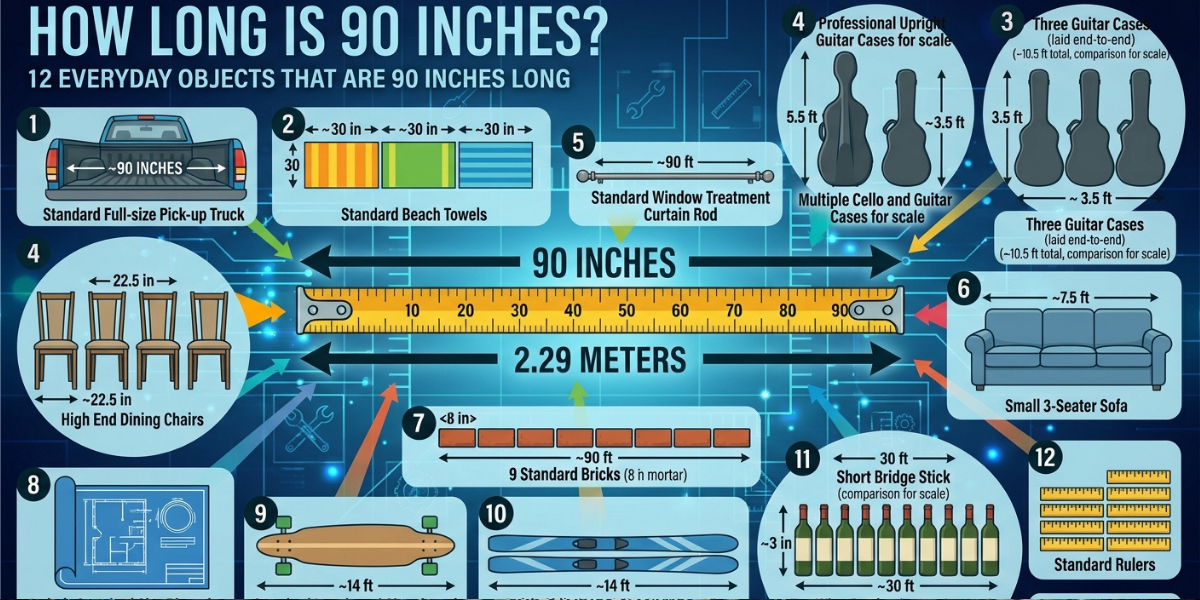
Have you ever wondered how long 90 inches really is? This measurement can be difficult to picture if you are unfamiliar with inches. Comparing it with everyday objects, furniture, and common household items makes it much easier to understand.
Ninety inches is equal to 7.5 feet, or 7 feet 6 inches. It is also approximately 2.29 meters long. This is a substantial length for many household items, making it useful to understand when measuring furniture, planning a room, or comparing the sizes of different objects.
In this guide, we will explain how long 90 inches is and compare it with 12 everyday objects. You will also learn how to convert 90 inches into feet, centimeters, and meters, along with practical ways to visualize this measurement at home.
How Long Is 90 Inches?
90 inches is equal to 7 feet 6 inches, 7.5 feet, or approximately 2.29 meters.
Since one foot contains 12 inches, you can convert 90 inches into feet by dividing 90 by 12.
90 ÷ 12 = 7.5 feet
The decimal value of 7.5 feet represents 7 feet and another 6 inches.
Here is a quick overview of the measurement.
| Measurement Unit | Equivalent |
|---|---|
| Inches | 90 inches |
| Feet | 7.5 feet |
| Feet and inches | 7 feet 6 inches |
| Yards | 2.5 yards |
| Meters | 2.286 meters |
| Centimeters | 228.6 cm |
| Millimeters | 2,286 mm |
For example, imagine measuring a straight line across a large room. A distance of 90 inches would cover more than seven feet, making it longer than many sofas and standard household tables.
12 Everyday Objects That Help You Visualize 90 Inches
The following examples will help you understand how long 90 inches is. Some objects may measure close to this length, while others can be combined to demonstrate the same distance.
Actual dimensions vary by product, design, and manufacturer. Use these comparisons as visual guides rather than assuming every example measures exactly 90 inches.
1. A Large Sofa
A large sofa is one of the easiest ways to visualize a length of 90 inches.
Many three-seat sofas measure approximately 72 to 90 inches wide. Some larger models exceed 90 inches, while compact sofas are considerably shorter.
A sofa measuring 90 inches from one armrest to the other would be exactly 7 feet 6 inches wide.
Imagine placing a sofa against a living room wall. The distance from its left armrest to its right armrest could span almost eight feet.
This comparison is especially useful when shopping for furniture or deciding whether a sofa will fit in your living room.
Before buying one, check its listed width. Manufacturers sometimes include the full outside dimensions, which may differ from the usable seating area.
2. A King-Size Bed’s Length and Width Combined
A standard US king-size mattress measures approximately 76 inches wide and 80 inches long.
Although neither measurement reaches 90 inches, the width is fairly close. It is only 14 inches shorter than 90 inches.
This makes a king-size bed a useful reference for understanding the scale of the measurement.
Imagine standing at the foot of the bed and looking across its width. The distance is about 6 feet 4 inches, which is substantial but still shorter than 90 inches.
If you are measuring a bedroom, remember that the mattress dimensions do not include the bed frame. The complete bed may require additional space.
3. A Standard Interior Door’s Height and Width Combined
Many standard interior doors in the United States are approximately 80 inches tall and 28 to 36 inches wide.
The height alone is close to 90 inches. An 80-inch door is 10 inches shorter than this measurement.
Imagine standing beside a typical interior door. Its top edge would reach a little below the 90-inch mark measured from the floor.
This comparison helps you visualize 90 inches vertically rather than horizontally.
Door dimensions vary depending on the building, country, and door type. Some doors are taller than the common 80-inch size, so check the actual measurement when accuracy matters.
4. A Dining Table With Extra Leaves
Some large dining tables measure around 72 to 90 inches long when extended.
An extended dining table measuring 90 inches would provide a direct example of this length.
Imagine a large dining table prepared for a family gathering. Measuring from one short end to the other would cover 7 feet 6 inches.
This size can provide space for several place settings, depending on the table’s width and seating arrangement.
Not every dining table reaches 90 inches. Some are much shorter when their extension leaves are removed, while others extend beyond this length.
If you are planning a dining room layout, measure the table and allow extra space for chairs and people to move comfortably.
5. Three 30-Inch Suitcases Placed End to End
Large suitcases vary in size, but some travel cases measure close to 30 inches along their longest dimension.
If you had three objects that each measured exactly 30 inches, placing them end to end would produce a combined length of 90 inches.
The calculation is straightforward:
30 inches × 3 = 90 inches.
This example is useful because it demonstrates how smaller lengths combine to create a much longer distance.
However, many large suitcases are shorter than 30 inches, and their wheels or handles may affect their total dimensions.
For an accurate comparison, measure each suitcase along the same dimension before arranging them in a straight line.
6. A Large Television’s Width and Viewing Setup
Large televisions are often described by their diagonal screen size rather than their width.
For example, a 90-inch television has a diagonal screen measurement of 90 inches. This is different from saying that the television is 90 inches wide.
A typical widescreen television with a 16:9 aspect ratio and a 90-inch diagonal has a screen width of approximately 78.4 inches and a screen height of approximately 44.1 inches.
That means its screen is shorter than 90 inches across, even though its advertised diagonal measurement is 90 inches.
This is an important distinction when comparing electronics.
If you need a television that fits a 90-inch-wide space, check its actual width, including the frame or bezel, rather than relying on the diagonal screen size.
7. A Large Desk and a Small Side Table Combined
A large office desk may measure approximately 60 inches wide, while a small side table might measure around 30 inches across its longest dimension.
If the two objects measure exactly 60 and 30 inches, respectively, their combined lengths would equal 90 inches when placed end to end.
60 inches + 30 inches = 90 inches.
Imagine a home office with a large desk positioned next to a small table. The combined length would be 7 feet 6 inches.
This example is useful when arranging furniture in a home office, bedroom, or multipurpose room.
Remember that the dimensions of desks and side tables vary. The calculation works only when the individual objects have the stated measurements.
8. A Large Bookshelf
Some wide bookshelves measure between 60 and 90 inches across, depending on their design and intended use.
A bookshelf measuring 90 inches wide would stretch across a distance of 7 feet 6 inches.
Picture a long bookcase filled with books, storage baskets, and decorative items. It could occupy a substantial portion of a living room or home office wall.
This comparison can help you estimate how much wall space is needed for large storage furniture.
However, a tall bookshelf may have a much smaller width than its height. Always distinguish between the object’s height, width, and depth.
If you are buying a bookshelf online, look for the complete dimensions rather than relying on product photos.
9. A Long Kitchen Countertop Section
Kitchen countertops are commonly measured in inches when cabinets and work surfaces are installed.
A countertop section measuring 90 inches would be 7 feet 6 inches long.
Imagine a straight countertop extending along one side of a kitchen. A 90-inch section could provide considerable workspace for preparing food, placing small appliances, or arranging kitchen supplies.
The actual amount of usable space depends on the countertop’s depth and any areas occupied by a sink, stove, or other fixtures.
This measurement can be helpful when planning a kitchen renovation or estimating the length of a work surface.
For installation, measure the available space carefully and account for corners, cabinet dimensions, and appliance openings.
10. Seven and a Half One-Foot Rulers
A standard ruler used for measuring one foot is 12 inches long.
Seven and a half one-foot rulers would create a combined length of 90 inches when aligned end to end.
The calculation is:
7.5 × 12 inches = 90 inches.
This is a simple mathematical comparison that makes the measurement easier to understand.
You do not necessarily need seven and a half physical rulers. A tape measure marked in feet and inches can show the same distance directly.
Alternatively, you can mark seven separate one-foot sections and then add another six inches.
This method is useful for school projects, home measurements, and understanding how inches relate to feet.
11. A Large Window’s Width
Large windows can vary considerably in size, but some wide window openings approach 90 inches across.
A window opening measuring 90 inches would span 7 feet 6 inches from one side to the other.
Imagine a broad window in a living room overlooking a garden. Its width could provide a useful visual reference for this measurement.
This comparison is especially helpful when planning curtains, blinds, or window treatments.
However, window measurements can refer to the frame, the rough opening, or the visible glass area. These are not always identical.
If you are ordering custom curtains or replacement windows, measure the exact area required by the manufacturer.
12. A Large Rug’s Longest Dimension
Some large area rugs measure 90 inches along one side, although common rug sizes vary by style and intended use.
A rug measuring 90 inches long would cover a distance of 7 feet 6 inches from one end to the other.
Imagine a rug placed under a coffee table in a living room. Its length would be substantial enough to help define the seating area, depending on the room and furniture arrangement.
This example is useful when selecting a rug for a bedroom, office, or living space.
Remember that rugs are generally described using two dimensions, such as length and width. A rug that measures 90 inches long may have a much smaller width.
Check both measurements before purchasing one.
How Does 90 Inches Compare With Other Lengths?
Comparing 90 inches with familiar measurements makes it easier to understand its size.
| Length | Equivalent in Inches | Difference From 90 Inches |
|---|---|---|
| 24 inches | 24 inches | 66 inches shorter |
| 36 inches | 36 inches | 54 inches shorter |
| 48 inches | 48 inches | 42 inches shorter |
| 60 inches | 60 inches | 30 inches shorter |
| 72 inches | 72 inches | 18 inches shorter |
| 84 inches | 84 inches | 6 inches shorter |
| 90 inches | 90 inches | Reference length |
| 96 inches | 96 inches | 6 inches longer |
| 108 inches | 108 inches | 18 inches longer |
| 120 inches | 120 inches | 30 inches longer |
For example, 90 inches is 18 inches longer than 72 inches. It is also 30 inches longer than 60 inches.
These differences are useful when comparing furniture, curtains, storage equipment, and other household items.
How to Measure 90 Inches Without Guessing
If you need to measure 90 inches at home, several simple methods can help.
Use a Tape Measure
A tape measure is the most straightforward option.
Extend the tape along a straight surface until you reach the 90-inch mark. If your tape displays feet and inches, look for the 7-foot-6-inch mark.
Keep the tape straight and avoid stretching it diagonally across the area.
Divide the Distance Into Smaller Sections
If your measuring tool is shorter than 90 inches, divide the distance into manageable sections.
For example:
- First section: 30 inches
- Second section: 30 inches
- Third section: 30 inches
The total is 90 inches.
Mark the endpoint of each section and keep the measurements aligned. This method works well with a short ruler or measuring stick.
Convert Inches Into Feet
You can also use feet to visualize the length.
Divide 90 by 12:
90 ÷ 12 = 7.5 feet.
This means that 90 inches is 7 feet 6 inches.
If you are more familiar with feet than inches, this conversion can make measuring a room or comparing furniture much easier.
Use an Object With a Known Length
If you have an object measuring 45 inches, two lengths of that size will equal 90 inches.
Likewise, three objects measuring 30 inches each will create a total of 90 inches when arranged end to end.
This method is suitable for rough estimates, but a tape measure is better when you need an exact result.
Where Is a Length of 90 Inches Useful?
Understanding 90 inches can help with several everyday tasks.
Furniture shopping: Check whether a large sofa, bookshelf, or dining table will fit along a wall.
Bedroom planning: Compare bed dimensions, furniture placement, and available walking space.
Home improvement: Estimate the length of a countertop, window opening, or storage area.
Curtain installation: Convert measurements into inches when ordering curtains or fabric.
Office setup: Plan the arrangement of desks, shelves, and other furniture.
Moving and storage: Estimate whether long items will fit through a doorway or into a storage area.
Although visual comparisons are helpful, always measure the actual item and the available space before making a purchase.
An object may fit along a wall but still be difficult to move through a doorway because of its height, width, or shape.
Frequently Asked Questions
1. How many feet is 90 inches?
Ninety inches equals 7.5 feet, or 7 feet 6 inches. Divide 90 by 12 to convert inches into feet.
2. How many centimeters are in 90 inches?
Ninety inches equals 228.6 centimeters. Multiply 90 by 2.54 to convert inches into centimeters.
3. How many meters is 90 inches?
Ninety inches equals 2.286 meters, which is approximately 2.29 meters.
4. Is 90 inches longer than 7 feet?
Yes. Seven feet equals 84 inches, so 90 inches is 6 inches longer than 7 feet.
5. Is 90 inches the same as 7 feet 6 inches?
Yes. Seven feet equals 84 inches, and another 6 inches brings the total to 90 inches.
6. How many yards are in 90 inches?
Ninety inches equals 2.5 yards because one yard contains 36 inches.
90 ÷ 36 = 2.5 yards.
7. Is a 90-inch sofa large?
A sofa measuring 90 inches wide is generally considered a large sofa. However, its seating capacity and overall size depend on the design, armrests, and seat configuration.
8. How can I visualize 90 inches without a ruler?
Imagine a straight line measuring 7 feet 6 inches. You can also picture three 30-inch sections placed end to end to create the same length.
9. Is a 90-inch television 90 inches wide?
No. Television screen sizes are generally measured diagonally. A 90-inch television with a 16:9 screen has a screen width of approximately 78.4 inches, excluding the frame.
10. What is half of 90 inches?
Half of 90 inches is 45 inches, which equals 3 feet 9 inches.
11. How many millimeters are in 90 inches?
Ninety inches equals 2,286 millimeters. Multiply 90 by 25.4 to convert inches into millimeters.
12. Is 90 inches a good measurement for furniture?
It can be a suitable length for large furniture, including some sofas, dining tables, and bookshelves. Whether it works for your space depends on the room dimensions and the item’s complete measurements.
Final Thoughts
Ninety inches is equal to 7 feet 6 inches, 2.5 yards, or approximately 2.29 meters. It is a useful measurement to understand when shopping for furniture, planning a room, or working on home improvement projects.
Large sofas, extended dining tables, wide bookshelves, and long countertop sections can help you visualize this distance. You can also imagine three 30-inch sections placed end to end to create exactly 90 inches.
Keep in mind that everyday objects come in different sizes, so these comparisons are only visual guides. When accuracy matters, use a tape measure and check the actual dimensions of the item you are measuring.
Leave a Reply